
by Aleksi Barrière
PICTURE A DAY LIKE THIS
Music: George Benjamin
Text: Martin CrimpStage direction, set design, dramaturgy & lighting design: Daniel Jeanneteau, Marie-Christine Soma
Conductor: George BenjaminWoman: Marianne Crebassa
Zabelle: Anna Prohaska
Lover 1 / Composer: Beate Mordal
Lover 2 / Composer’s Assistant: Cameron Shahbazi
Artisan / Collector: John Brancy
Actors: Lisa Grandmottet, Eulalie Rambaud, Matthieu Baquey
Orchestra: Mahler Chamber OrchestraCommissioned and coproduced by Festival d’Aix-en-Provence, Royal Opera House – Covent Garden, Opéra national du Rhin, Opéra Comique, Théâtres de la Ville de Luxembourg, Oper Köln, Teatro di San Carlo.
Premiered on July 5, 2023 at the Festival d’Aix-en-Provence.
*
VIOLET
Music: Tom Coult
Text: Alice BirchCo-commissioned by Britten-Pears Arts & Music Theatre Wales, with assistance from Theater Ulm.
Premiered on June 3, 2022, at the Aldeburgh Festival.
New production by compagnie L’Aurore boréale, coproduced by ENS-Paris Saclay, corealized with La Vie Brève / Théâtre de l’Aquarium.
Director: Jacques Osinski
Conductor: Bianca ChillemiStage Design : Yann Chapotel / Lighting Design : Catherine Verheyde / Costumes : Hélène Kritikos / Dramaturgy : Marie Potonet
Violet: Juliette Allen
Felix: Olivier Gourdy
Laura: Natalie Perez
Clockkeeper: Manuel Nuñez CamelinoEnsemble: Ensemble Maja
Presented at the Théâtre de l’Aquarium on June 23-25, 2023, in the framework of Festival BRUIT.
*
THE FAGGOTS AND THEIR FRIENDS BETWEEN REVOLUTIONS
Based on the cult fantasy novel by Larry Mitchell and Ned Asta
Music: Philip Venables
Direction and Text: Ted Huffman
Music Direction: Yshani PerinpanayagamChoreography and Costume Design: Theo Clinkard / Set Design: Rosie Elnile / Lighting Design: Bertrand Couderc / Sound Design: Simon Hendry / Dramaturg: Scottee / Assistant Director: Sonoko Kamimura / Costume Collaborator: Sophie Donaldson
Cast: Yshani Perinpanayagam, Kerry Bursey, Deepa Johnny, Jacob Garside, Katherine Goforth, Kit Green, Conor Gricmanis, Mariamielle Lamagat, Eric Lamb, Themba Mvula, Meriel Price, Collin Shay, Joy Smith, Sally Swanson and Yandass
Commissioned by Factory International, Festival d’Aix-en-Provence, Bregenzer Festspiele, the Southbank Centre and NYU Skirball. Produced by Factory International for Manchester International Festival.
Premiered on June 29, 2023 at the Manchester International Festival.
I do not want to read too much into the alignment of events: the preeminence with which British artists have recently been featured on the Continent certainly is a byproduct of multiple factors, among which the vitality of the British scene and the dire straits in which it currently finds itself, in the face of Brexit and the defunding of the arts. Regardless of the causes, such an alignment has recently allowed for me to witness three examples of new chamber opera hailing from the UK in France, by composers George Benjamin, Philip Venables, and Tom Coult respectively. Whether it makes any sense to lump together the productions I have seen simply because their three composers are British is what I am, contextually, compelled to explore here.
The reason one might want to look at these pieces together is not so much a matter of nationality per se as, more specifically, the existence of a distinctly British tradition of chamber opera. The very phrase chamber opera has strong historical connotations. In the 20th century, plenty of forms have been developed to approach the stage through the means of music while circumventing the grand opera tradition, either confrontationally negating it by claiming labels such as anti-opera and non-opera, or by building on other disciplines and their own artistic tools, which has allowed various forms of intermedial crossings: music theatre, dance theatre, instrumental theatre, composed theatre… Using the word opera is not necessarily, by contrast, a profession of conservatism; however I will argue that speaking of chamber opera is not a purely semantic choice, but does frame the endeavor in a specific way: it taps into the historical tradition of the medium – drama performed by accompanied singers, with a certain set of techniques – and contains the idea of adapting the form to a smaller scale.
The phrase chamber opera contains a somewhat provocative oxymoron that has been eroded by repeated usage: in the aftermath of the form’s expansion in the 19th century, opera connotates opulence of means, and if not aristocratic pleasure then a mass medium, possibly tainted by the Wagnerian undertones of ceremoniously converging arts, crafts and social classes. Stating that this could or should be condensed into the means of chamber music is in itself revolutionary, and has two main implications that have been ingrained into the DNA of what has grown into a genre of its own: artistically, focusing on the fine craft of a smaller form with a reduced team, and reaching for the intimate quality that in parallel was sought by the Kammerspiel trend in the field of theatre; and economically, working with more limited resources and allowing for lighter productions to exist outside of great institutions and urban centers.
In the early 20th century, many new forms were born in times of economic crisis (and eventually political oppression), with composers finding inspiration in the cabaret and jazz scenes (Schönberg, Weill, Martinů, Groupe des Six) and/or the conventions of puppetry and dance (Stravinsky, Hindemith, de Falla), and exploring the entire range between interventionist agit-prop and revival of the Baroque intermezzo format – this movement was also paralleled by and sometimes intersecting with similarly transdisciplinary ventures stemming from visual arts, theatre, and poetry. This intense period of formal creativity, born in the margins, expanded the grammar of possibilities well beyond anything that can be consistently called opera, and gave birth to the post-war field of music theatre, which thrived in particular in Italy and Germany.
This context is important to recall because, despite similar material conditions of emergence (which are to be expected from contemporaneous phenomena) and occasional overlaps in makers, on this backdrop chamber opera appears to be a more specific concept than the broader field of music theatre, and perhaps ontologically different insofar that it places itself in direct continuity with the form of opera and its uninterrupted history. Which is not to say that it is impermeable to influences from other genres and media, and that is not trying to update it or even subvert some of its historical features, as large-scale contemporary opera might – but it does so within an inherited framework that begs specific questions. The main issue chamber opera is bound to raise is the bearing of its chamber quality on opera as a form; or to put it bluntly: does chamber opera contribute to opera by virtue of the specific possibilities of its format, or is it bound to be only a cheaper, lighter version of a larger form? Is its appeal only to be opera that is easier to produce, suited for outreach projects and student productions – meaning it is to be eternally construed as a mere ersatz, an affordable substitute to and antechamber for the ‘real thing’?
The United Kingdom has enjoyed a lively tradition of chamber opera and is rich with countless companies specialized in the format, producing new works for small ensembles as well as Baroque works with smaller casts and instrumentations, and classical works in reduced orchestrations. It has its household names, such as the Birmingham Opera Company (previously the City of Birmingham Touring Opera) and the Grimeborn and Tête à Tête festivals. Within each new generation of British and Irish composers, the term chamber opera has been reclaimed, regardless of individual aesthetics, for instance by Harrison Birtwistle, Gavin Bryars, Judith Weir, Mark-Anthony Turnage, Thomas Adès, Jennifer Walshe, Stuart MacRae, among others. The importance of the British chamber opera continuity is grounded in many historical factors – that are to be contrasted with the impact of a more multifaceted music theatre movement on the Continent – but one central genealogical element is its association with the figure of Benjamin Britten.
The creation by Britten of the English Opera Group in 1947, of its home base the Aldeburgh Festival in 1948, and of the many chamber operas he composed for them, epitomizes every fundamental aspect of chamber opera: opera in continuity with the historical form made by artists either ill-treated by the official institutions (Covent Garden and Glyndebourne) or disillusioned with the possibility of creating meaningful art within them, intent on building their own production tools to be able to make opera on their own terms, while also holding firm beliefs as to the necessity of decentralizing art production and reception, which has led to projects involving new audiences directly. These features cannot be separated from the aesthetic language in which they were cast. Britten’s success as a composer lies not only in his artistry, but also in his fine balance between self-conscious national roots and cosmopolitan curiosity, and in a musical idiom revolving around a certain tonal ambiguity that allows both for a traditional, euphonic listening coordinate system and a certain margin of experimentation. Britten is the poster boy for chamber opera precisely because he created forms that feel like strong operas in the traditional sense, without making the smaller scale feel contrived – they are well-made and contain all the elements expected from seasoned operagoers (the vocal bravura set in an engaging orchestral context and, more often than not, the thrill and violence), all while being extremely well thought-out dramaturgically with his collaborators for unconventional durations and contexts. The three ‘Church parables’ of the 60s are tailored for church acoustics and performance without a conductor, even managing daring timbral and rhythmical explorations in the process. War Requiemand Owen Wingrave broke ground in terms of cross-media creation. The participatory works and the children’s operas are models in their respective genres and have been successful for reasons intrinsic to Britten’s idiom, that have also elicited disdain from the avant-garde. I have been often surprised (coming from a more confrontational continental tradition) to hear even young British opera-makers laud The Rape of Lucretia, Albert Herring and especially The Turn of the Screw as unsurpassable masterworks of music theatre that one can only attempt to emulate, in the hope of being worthy of taking up the torch.
All this might seem like an overly stretched out introduction to a review of new opera. This is because I will not produce a review, really, but wish to share impressions and thoughts on three new works, in the light of each other and of this specific chamber opera paradigm. For this same reason I will not be comprehensive, and will rather discuss the works themselves (as pieces of music and dramaturgy) than the productions in which they were presented, despite the fact that there would be much to say about them.
*
PICTURE A DAY LIKE THIS (George Benjamin/Martin Crimp). The much anticipated fourth collaboration between composer George Benjamin (*1960) and playwright Martin Crimp (*1956) had its premiere at the Aix-en-Provence Opera Festival this summer, conducted by the composer. Its distinctive trait, after the two larger operas Written on Skin (2012) and Lessons in Love and Violence (2018), was precisely to revisit the chamber format, which is where the pair started with their first joint project: the miniature Into the Little Hill, premiered in 2006 in collaboration with director Daniel Jeanneteau, who also returns to stage this new opus. From its size slightly larger than its predecessor – five singers instead of two, an orchestra of 22 instead of 15, and a running time of 75 minutes instead of 40 –, Picture a Day Like This nonetheless embraces the historical form of chamber opera, with a young cast of light voices playing multiple roles, supported by a conventional small instrumental ensemble. The work was presented in the small horseshoe 18th-century Théâtre du Jeu de Paume, organically suited to Baroque music and by extension to newer operas of this scale, and could easily live in more modular spaces.
Like Into the Little Hill, which was based on the legend of the Pied Piper of Hamelin, Picture a Day Like This is a linear retelling of a traditional fable, drawing on multiple versions of the story of a protagonist sent on a quest to find one happy person, doing so being the condition to defeat death. In this opera, the protagonist is a woman who lost her child, whom she is told she can bring back if she can produce a button from the sleeve of a happy person. She is provided with a roadmap, a page “torn from an old book”, indicating where to go and who she will meet. On this scripted journey she meets a series of contrasted characters: two lovers, a retired skilled artisan, a successful composer, a rich art collector, and a woman living a peaceful life in her garden.
Discovering the premise in the first few minutes of the work, one has an immediate expectation of what will happen: each encountered person will look happy at first glance but actually turn out to be miserable, and we will learn that death cannot be defeated. The most striking aspect of Picture a Day Like This is that it makes no effort at surprising the audience by contradicting this expectation. The piece’s way of owning to its straightforwardness is the device of the script given to the protagonist, which she obediently follows, making it part of the narration that the play with the universal morphology of folk tales is conscious (“no one can alter it,” the protagonist ends up professing). But there is not much play in this play, and each tableau updates the morality genre without really challenging it: greed, ambition, lust are depicted in a humane and empathetic way typical of Crimp, in which however no ambiguity is to be found. When it is revealed that the male Lover has been lying about actually indulging in a form of fluid polyamory presented as trendy, that the arrogant composer is actually riddled with crushing doubts, or that the affluent art collector who introduces himself as a philanthropist is lonely and in search of something like an escort (non-sexual, he insists), one cannot escape an impression of first-degree preachiness that elaborates on a preachy storytelling tradition without transcending it. The conclusion tries to blur the piece’s straightforward morality in the clumsiest way possible, an open ending: apparently defeated after witnessing everyone’s misery, the protagonist has nevertheless recovered a button from her doppelgänger, a woman who has survived a tragedy similar to her own. Has she triumphed literally or metaphorically, learned about resilience, the ultimate reward in the journey of grief? We are left to draw our own conclusions, but the moralistic narrative frame remains unshaken.
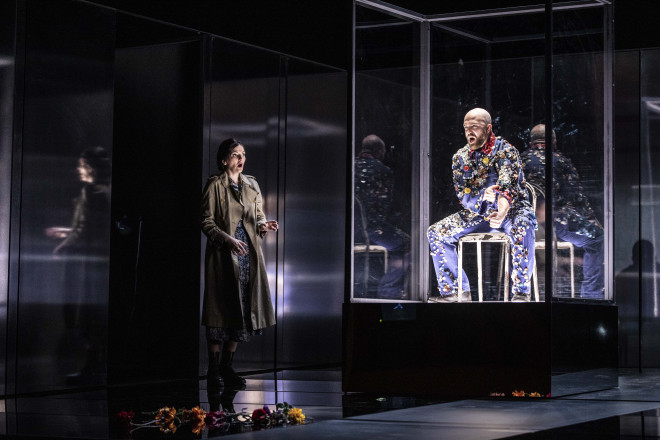
This could also describe the compositional attitude George Benjamin developed to the text he set to music. Benjamin rose masterfully to the obvious challenges intrinsic to the project: the chamber ensemble, classically constructed, skillfully emulates the palette of his larger orchestrations; each role is lovingly tailored for the voice of the performer for whom it was written; and the Duke Bluebeard’s Castle-esque structure allows for contrasted tableaux in which – as is also customary in the morality play tradition – the many shades of vice are an opportunity to relish in seductive colors, on both the vocal and instrumental fronts. Equally successful is the manufacturing of a main protagonist who drives the entire arc without interruption (also serving as a narrator, as per Crimp’s usual meta-diegetic treatment of his characters) with richness and variety, well served by a strong performance by mezzosoprano Marianna Crebassa. But the overall effort feels like meticulous coloring without going over the lines, an impression that can only be amplified by the linearity of the text. However the text is not the main reason to the piece’s tameness, which has more to do with a through-composed quality that doesn’t allow for much friction. Programmatically, the opera starts with the moving naked statement by the protagonist of the loss of her child as a monologue sung a cappella (but avoiding speech, which Benjamin states he dreads in opera). The orchestra’s instruments are gradually introduced until the band is put together, never to be dismantled again. It is revealing that the first sound we hear is not from the singer, but from the harp that starts the piece by giving her her note: the orchestra is an accompanist, and is generously serving the vocal lines throughout the piece, always helping the singers with pitches and flattering their projection with subservient transparency reminiscent of Britten. This hierarchy, as much as all the structuring hierarchies of the piece, is never challenged. Everything falls perfectly in place, much like the vocal lines fit their performers in the fashion of bespoke tailoring. It might seem audacious to say this as if it were a fault, but there is something uncomfortable, when experiencing a work of art, in feeling like one is privy to a well-executed task – in this case, the task of creating a chamber opera.
VIOLET (Tom Coult/Alice Birch). In a coincidence that invites comparison, two weeks before the prestigious premiere in Aix, another British chamber opera was being presented at the festival organized by the Théâtre de l’Aquarium (in Vincennes next to Paris), a venue focused on interactions between theatre and music from a theatre perspective. The comparison is further stimulated by the fact that the opera in question, Violet, is the work of the next generation, namely playwright Alice Birch (*1986) and composer Tom Coult (*1988), a former student of Benjamin’s at King’s College London. One can only be curious to see what they would do with the form, especially since Violet has received much praise and this new iteration – produced and directed by Jacques Osinski and his independent company L’Aurore boréale, in collaboration with Ensemble Maja conducted by its artistic director Bianca Chillemi – is already the third production of the work since its premiere in June 2022 at the Aldeburgh Festival, Britten’s haven. The cast and instrumentation are concentrated, but by no means meagre: four singers and thirteen players.

Alice Birch, known for large-scale work manipulating ensemble casts, such as the play Anatomy of a Suicide directed by Katie Mitchell (2017) or the screenplay for the Netflix film The Wonder (2022), went for the core of the form and wrote her libretto as a psychological chamber play that unfolds entirely behind closed doors. Despite the stark contrast in which this choice of dramatic genre stands to the two more narrational Benjamin/Crimp chamber operas, like them Violet takes the form of a parable. What we are looking at is an apocalyptic scenario, coated in a premise reminiscent of magical realism, inspired by Poe’s The Devil in the Belfry: in a small town regulated by repetitive middle-class routine, the town clock suddenly starts skipping hours, meaning each day is shorter than the last; the rising awareness of impending doom in the community leads to panic, chaos and mayhem. Interestingly, the opera examines this intrinsically political disruption entirely through the private lens of one couple and their maid (plus occasional visits from the town’s Clockkeeper). The husband, Felix, is a conformist with dreams of militant normalcy that at home translate into manipulative possessiveness. The wife, who holds the titular Ophelian name Violet, is a prisoner of this home, the life that is represented precisely by the ticking of the clock, and the ensuing depression to which she sees no end. We follow her awakening as the collapse of the clock-time, of which she is the first to become aware, reinvigorates her into rebellion.
The character of Violet, performed with precision and engagement by Juliette Allen, is the evident centerpiece of the work, and offers a most welcome modern and nuanced take on the archetype of the sickly young woman suppressed by psychiatric patriarchy, as her melancholy is brandished as a mirror of the zeitgeist and explores a peculiar and topical form of end-of-the-world euphoria. In that specific respect, the text is somewhat undermined both by Coult’s musical treatment, that amorously embraces the stereotypes of the melismatic madness aria, and in this instance a staging that traps the character into the white gown cliché. This is not for lack of caring about the character, and like Benjamin, Coult devotes his orchestration to supporting his lead. To a fault, one could argue, as the ensemble often vanishes entirely into sheer ethereal harmonies, and even the most obvious matrix for musical material – the clock – is hardly subjected to any substantial development. Paradoxically, the notion of accelerating time itself doesn’t get strong support from the music, as Coult’s atmospheric idiom doesn’t easily lend itself to fragmentation, and doesn’t have the variety that was instilled for instance in Benjamin by exposure to more diverse influences.
Insisting on the comparison with Picture a Day Like This would be inequitable despite many similarities, for all the obvious reasons: it is the work of a less experienced team, presented in material conditions hardly comparable to the full resources of a festival like Aix’s. In that respect, the sheer existence of something of this scale outside of operatic institutions should only be lauded and encouraged. But there are specific qualities that one might look for precisely in such contexts, apart from the discovery of fresh talent of which there is plenty here: chiefly, resourcefulness and a desire to challenge expectations. It is invariably surprising to see a generation pool their creative minds and resources, and choose to create a miniature emulation of institutional models, instead of exploring new directions. Love for what came before is a respectable drive and a potent force of influence, both conscious and unconscious (and the shadow of The Turn of the Screw does loom over Violet in many ways), but if new things are not tried out in the chamber format, then where?
THE FAGGOTS AND THEIR FRIENDS BETWEEN REVOLUTIONS (Philip Venables/Ted Huffman). After this Parisian detour, cut back to the 2023 Aix-en-Provence festival, with the French premiere – or, as the program booklet states in a post-Brexit quip, the ‘European premiere’ – of The Faggots and their Friends Between Revolutions, just a week after its world premiere at the Manchester International Festival. A piece that in comparison with the two previous ones has little connection to the structural features of opera, Faggots would definitely fall into the continental category of music theatre, but we will see how it also connects to the chamber opera tradition, in addition to the fact that composer Philip Venables’s (*1979) and librettist/director Ted Huffman’s (*1977) two previous stage works were explicitly named chamber operas. The works in question were already strongly bending the conventions of the form: 4.48 Psychosis (2016) diffracted Sarah Kane’s monologue between six singers and developed multimodal forms of text delivery (sung, spoken, projected), while Denis & Katya (2019) confronted multimedia documentary material with two singers each performing multiple roles. Although Venables’s stage works have been commissioned by and performed in opera houses, and have elicited new productions in the same way as any classically scored work can, they demand human and technical resources and rehearsal protocols that are not typical of the institution – they create unusual bridges between the opera world and the new music circuit. In Faggots, the departure from the notion of opera is more marked than in the composer’s previous ventures. The work does remain an opera, referentially, by choice of production circuit, and through the fact that it is ostensibly constructed through playful reversal of opera as it is typically reproduced in chamber opera too: individual protagonist into collective experience, unity into diversity, hierarchy of taste into eclecticism, hierarchy of the classical orchestra into anarchistic modularity.
Originally, The Faggots and their Friends Between Revolutions is an unconventional novel, written by Larry Mitchell in 1977 as a series of scenes and reflections on the life of ‘the faggots’ (and their friends: the faeries, the queens, the women who love women, among others) in the margins of the society of ‘men’. Which is to say: this is a parable, once again. Better yet, it is a manifesto that celebrates queer communes, Mitchell having himself lived in one in the state of New York at the time. In their adaptation of the material – or rather setting, since Mitchell’s text has been sampled rather than adapted – Huffman and Venables have attempted to transform the very experience of the text into a communal one. The team is not divided into pit and stage, ensemble or cast. Instead, a motley group of 15 performers has been assembled, each with a different skill set, and the text is being performed by all of them in different combinations. This artists’ commune narrates, in speeches and songs, the tale of Mitchell’s fantasy world, which celebrates the emancipation of “the ones the men have decided to hate” from the warmongering society of men. They owe their liberation to their festive and solidary lifestyle, which is in itself a secession and a refusal to assimilate.
The score was conceived for the workshop process leading to the construction of this artistic commune, and has been assembled from different blocks of musical material, arranged collectively. Despite the exceptionally horizontal and fluid hierarchy between performers and media, which is the main statement that the piece makes in addition to the text it amplifies, there are formal frames, represented chiefly by performance artist Kit Green who serves as the main narrator and MC, and pianist-conductor Yshani Perinpanayagam. Other than that, each artist, spanning from opera singers and musicians working on period instruments to other more contemporaneous type of performance, gets to shine within a number structure that periodically merges into ensemble numbers (including the inevitable sing-along number involving the audience).

All of Venables’s music is postmodern and eclectic in style, and in previous work too he has kept at bay the idea of a singular compositional voice, be it conservative-classical or modern-expressionistic, sampling instead idioms, techniques and sources that suit his purpose. Here, by necessity of uniting performers of different backgrounds, the music is centered on the simplest common denominators, and it certainly does prove efficient in its function as connective tissue, although the charm of its melodic and harmonic fabric does wear out somewhat over 1h45 of performance. This is obviously a byproduct of the concept – as are the sometimes bland group exercises through which Huffman harmonizes the corporeality of the bodies that occupy the otherwise bare stage – but it is interesting that it derives also directly from a distinct feature of Venables’s other music, namely his limited use of layering and the strong focus on intelligibility that structures his prosody and accompanying instrumentation. That much of the Brittensian legacy remains, and connects Faggots to the aesthetics of the other chamber operas discussed here.
Illustrated by the limited musical lingua franca, remains the question of what we learn from this commune. Huffman and Venables have made an evident effort to update the text by highlighting its intersectional aspects and creating a broadly Sex Non-Conforming and diverse team to narrate it. But Mitchell’s manifesto fantasy was written in the peculiar age between the Stonewall uprising and the advent of the AIDS crisis, and the militant irenic hedonism it manifests feels a little off in our age. The queer community experiences strong divides that if anything are a reminder that forming a community is not an obvious, natural process, but requires plenty of friction, debate, negotiation, all of which simply doesn’t exist either in Mitchell’s text or in this piece, where acceptance triumphs and the only antagonist are outside forces of conformity, and those who collaborate with them. As a fable and a fantasy, Faggots claims that it could be that simple, that differences should be forgotten, that love trumps division – and that stance does exist in our world as well. But the parallel was striking when, on the stage of the Grand Théâtre de Provence next door, on the day I saw the performance, Berg’s Wozzeck was being put on, featuring in its central scene the disarticulated dance of a dysfunctional society trying to function around an upright piano, just like the one that takes the centre-stage in many collective moments of Faggots and holds the commune together. It is possible to articulate the complexity and dissonances of living together, the sheer work of it, into a piece of music theatre, and I cannot quite suppress the feeling that doing so is a greater feat than a staged party or a swiftly resolved harmony.
*
It would be preposterous to claim some kind of generalization could be inferred from the juxtaposed experiences of these three works, and examining them in this way certainly doesn’t do justice to everything they have to say individually. However, they do speak of certain trends, either together or in opposition to each other. On the most general level, I think they triangulate many properties of the chamber opera paradigm, which has prospered in particular in the British cultural context. Its most lively aspect, I believe, is its ability to create a more open form of opera in diverse places, reaching new audiences, creating circulations between different networks and worlds, and the production histories of these three works certainly is a testament to that. A less fortunate trait, to my ear, is the persistence of a strong Brittensian hierarchy in the organization of sound that favors and even flatters voice in successful ways, but limits considerably the possibilities of the form and, regardless of the idiom, impoverishes the artistic range of the whole in its ability to articulate a more complex and dynamic hierarchy of media. When in his note concerning Peter Grimes (1945), Britten himself rejected both traditional one-to-one English setting of text and Wagnerian permanent melody, calling for an alternation between natural prosody and “a high-handed treatment of words” that leaves more space for musical logic to unfold, he mapped out more dynamic routes than those of many composers who inherited other aspects of his vision of chamber opera and of his harmonic language, easily derived into all-too transparent or illustrative instrumental music.
Beyond such debates, one incredibly important aspect of the chamber opera paradigm is the creation of new works – these three operas are published scores that can be taken up by others –, to which the continental music theatre scene has been somewhat more averse lately, preferring collage works and remixed/reorchestrated readings of classics. The creation of new music, and furthermore its creation in diverse economical contexts, is a vital task that enriches our world with tools for artistic and cultural action, and creates more concrete possibilities for dialogue and collaboration than purely fluid forms. The drawback of chamber opera’s focus on an existing template is of course its stiffening into a closed form dominated by the cult of the ‘well-made play’, which can only degenerate into academism, bar the way to the evolution of forms, and devitalize existing forms of their meanings by removing the necessary friction between media, bound to coalesce and calcify into a new fixed medium: opera. In this respect, it is interesting that all three operas I have discussed take the form of parables – in appearance the most simple form of story, and therefore deemed suitable for a short work of modest proportions, but in reality incredibly difficult to manipulate when one is to use it to actually open a conversation. A parable should be an open form, generative of multiple meanings and discussions. Chamber opera has the potential of being exactly that on its own terms, if it is used as an open form and laboratory, and not as either a closed form or a rehearsal room for more prestigious arenas. In the word chamber opera, the productive tension between the words chamber and opera has to be kept alive.
| Aleksi Barrière (FR/FI) is a writer, stage director and translator. He is the cofounder of the music theatre group La Chambre aux échos and works in the grey areas between disciplines, languages and cultures. He collaborates with multiple composers both as director and librettist. |


 Theorema
Leave a reply to Aleksi Barrière Cancel reply