
by Aleksi Barrière
EROS/SA
Text created collectively from interviews conducted by the artistic team
Production: Post Theatre Collective
Stage direction: David Kozma
Performers: Eeva Putro, Timo Teern, Yuko Takeda, Rufaro Rwambiwa
Sound: Romulus Chiciuc, Robert Prokopowicz / Choreography: Angela Aldebds / Lighting: Pietu Pietiäinen / Set installation: Bita Razavi
Premiered at Pop Up Vuotalo organized by New Theatre Helsinki in the Fall of 2021.
Performances at KokoTeatteri on October 7-12, 2022.EROS
Composers: Biagio Marini, Claudio Monteverdi, Giovanni Felice Sances, Barbara Strozzi
Production: i dolci, Zodiak, Finnish Baroque Orchestra, Helsinki Early Music Festival
Conception: Marianna Henriksson & Anna Mustonen
Choreography: Anna Mustonen
Musical direction, cembalo, organ: Marianna Henriksson
Performers: Hanna Ahti, Mikko Hyvönen, Anna Kupari, Pier Kär, Eleni Pierides (dance), Tuuli Lindeberg, Sirkku Rintamäki (sopranos), Teppo Lampela (alto), Juho Punkeri (tenor), Jussi Lehtipuu (bass), and musicians of the Finnish Baroque Orchestra: Anne Pekkala, Hannu Vasara (violins), Hanna Pakkala (viola), Louna Hosia (cello), Anna-Rinta-Rahko (violone), Jani Sunnarborg (dulcian), Eero Palviainen (lute and guitar).
Dramaturge: Masi Tiitta / Costume Design: Piia Rinne / Lighting Design: Heikki Paasonen / Sound Design: Timo Kurkikangas / Producer: Riikka Thitz (i dolci)
Premiere and performances at Tanssin Talo on October 6-13, 2022.[ Bias Disclaimer: David Kozma and Marianna Henriksson are acquaintances and artistic collaborators. ]
During a certain week of October 2022, that Northern Europeans insist on designating as Week 41, I happened to see two shows in Helsinki, Finland. One was a theatre performance called EROS/SA, a pun on the name of the Greek god of love and desire and the Finnish word for ‘separated’, ‘divorced’ (erossa); the other was a dance and music performance simply titled EROS. The apparent coincidence in titles does not in itself justify examining two very different pieces next to each other in the same text. But surely it is no coincidence that Post Theatre Collective, a platform creating theatre that is international and intercultural at its core, and i dolci, a collective working on the overlaps between dance, music, and visual arts, would both reclaim the tutelage of Eros, whom Plato calls the metaxu, the ‘in-between’ and ‘intermediary’ that bridges and mixes worlds. Discussing these works together is also an opportunity to have a look at the active but insulated independent scene for performing arts in Finland.
EROS/SA presents itself as a form of lightly immersive documentary theatre: in the modular black box of KokoTeatteri (a small theatre in the neighborhood of Kallio, run by an independent company, that also welcomes guest performances such as this one and aims at steady state subsidies), we are invited to sit at any of four long tables arranged into a square. The setting is that of a wedding party, with the appropriate amount of kitschy LED washes (a reminder that the venue also doubles as a jazz club), but the tables have been styled to send a different message: used tableware, remnants of food and withered flowers suggest that the happy day took place a long time ago. Four actors sit with us, elegantly dressed for the occasion, and one after another they stand up as if to toast to a happy couple, but instead narrate in third person and in great detail the story of a failed relationship.
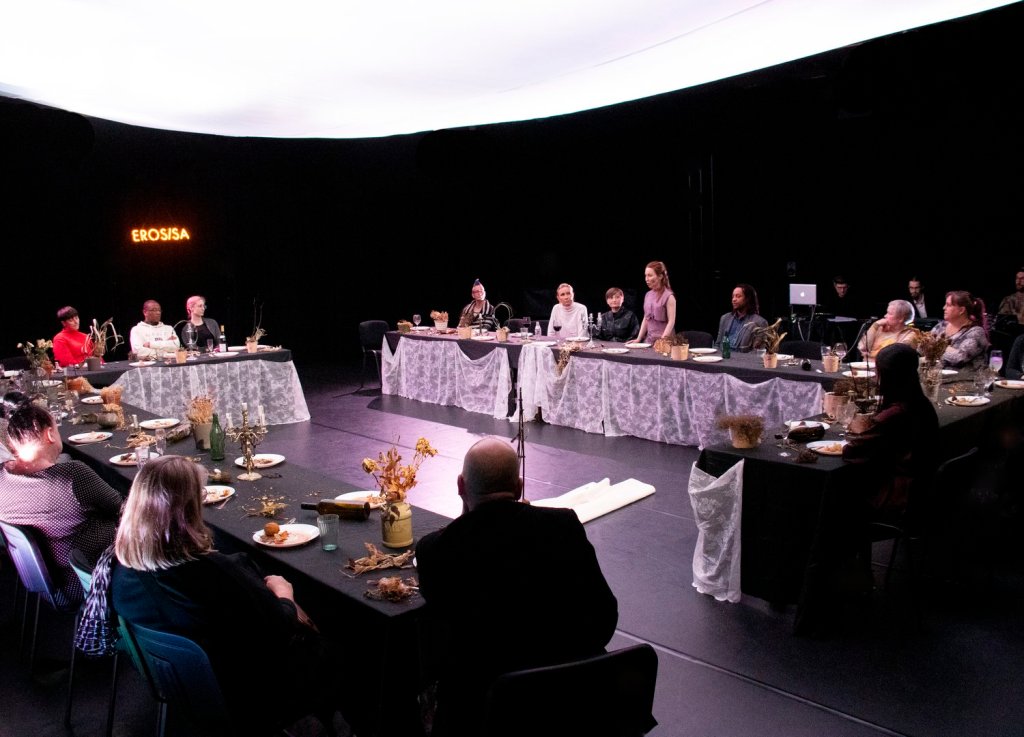
There are four of these stories, all exploring intercultural and interethnic love, and following the same general pattern – a foreigner moves to Finland to be with a Finnish person, and things gradually go down the drain. The stories were created from a dozen of interviews conducted by the show’s creative team, and unfold somewhat symmetrically: four actors for four stories; two Finnish actors (Eeva Putro and Timo Teern) are playing various Finnish characters, mostly in Finnish, while two Helsinki-based foreign actors (Yuko Takeda from Japan and Rufaro Rwambiwa from Zimbabwe) are playing characters from, respectively, Korea, the US, Nigeria and a nondescript African country, mostly in English; two stories are narrated from the point of view of the man, and two from the point of view of the woman. Each of these main characters whose vantage point we follow turns out being subjected to some form of psychological and/or physical abuse from their partner, leading to years of inadequacy and suffering, and ultimately to separation. The overall distribution of blame is just as symmetrical as the rest: women and men, Finns and foreigners can be just as manipulative and abusive, and the biggest differences lie in the ways of instrumentalizing cultural differences: dismissing their partner’s native culture, using their own background to justify their actions, or in the case of Finns straight out taking advantage of the power position of being in their homeland to create situations of material dependency. As is only fair in this context, the cultural paradigm of the Finnish individualistic man – driven by conformist dreams of a nuclear family and own house (omakotitalo), unable to express his feelings, and enabled to resort to alcohol and domestic violence as coping mechanisms – carries a heavier load and is examined more closely. This classic theme is still partly taboo in Finland, and when it was deconstructed for instance by writer Sofi Oksanen in an interview, it escalated into a great public controversy.
The performance is as tense and dark as one might expect, as the interwoven stories linearly mature towards their respective collapses, announced from the onset by the title and the scenography, and thereafter through uncommented (but underlined) tell-tale signs in the stories. Movements are spare, unadorned, concentrated around the tables, and mostly captured in cold monodirectional lighting. A discrete but relentless musical design continuously thickens the atmosphere. But the show is not without lightness and humor either, which are not to be found only in the few cathartic karaoke numbers that build on the wedding meta-story and allow everyone to blow steam, but more importantly in the focused range allowed by the general acting style. Adding to the intimacy of the set and space, the amplification of the actors’ voices allows them to effortlessly unfold the very narrational text and insert subtle nuances of empathy, only occasionally breaking into brief reenactment-dialogues and, in the final scene, into first-person monologues. Full-on transformations into the characters, when they occur, maybe feel less successful because they immediately come across as endowed with exaggerated pathos, compared to the bareness of the rest – which is also why the more contained performances of Yuko Takeda as Mi-Hee and of Timo Teern as Sami, where the characters’ social awkwardness plays at full, feel convincing in being aligned with the general understated tone of the show. There is tenderness in the way all these characters are offered to our scrutiny, although one might also grow suspicious about never hearing the point of view of their abusers – but this is after all no court of law and no claim is made at objectivity, and these ‘reconstructed’ testimonies receive no explicit commentary either but are offered in their direct bareness. Could the display of uncommented subjective narratives be seen as problematic? The seduction of documentary theatre lies in the feeling of consuming raw reality, a feeling obviously as ambiguous here as in any documentary format, that demands a more unconditional suspension of disbelief than fiction, and triggers an endless chain of questions that are not addressed within the show (is this the whole truth? did this story really happen as told? is the point invalid if this is fiction?). Stage director David Kozma and his Post Theatre Collective are extremely proactive in importing new texts and aesthetics from abroad (especially through their R.E.A.D. Festival, within which new drama has been premiered in Finland for nine years now) and have been instrumental in particular in giving a voice to immigrant actors and others climbing the social ladder in Finland. Their approaches to documentary in theatre have been manifold and varied. The blunt strength of EROS/SA – its raw directness – is also its formal limitation, since the monologic narration leaves less room for other voices and media than is usual for Post Theatre Collective. Music and movement too bow to the testimonies that make any ornamentation or stylization feel superfluous.
In the absence of commentary or of other voices, we are left to draw our own conclusions from the four stories. Conclusions that, in the light of this catalogue, could be overwhelmingly pessimistic about the very possibility of intercultural romance. But the range of problematic behaviors brought to our attention tends to demonstrate that the main difficulty really lies in romance itself – the challenges of interculturality merely amplify the individual’s struggle with social conventions at large, and provide additional opportunities for abusive behaviors, but they are not designated as the main issue. As Mi-Hee puts it at the end of the show: “When two people come from totally different backgrounds, it’s more difficult and needs more work.” The keyword here being ‘more’. EROS/SA tells delicately of four couples falling in love and later separating, but in between it tells of the labor of love, of a possible definition of Eros as the divinity of the difficulty of bringing different people together, of ‘making things work’ – a perilous and at times dangerous process that romantic relationships share with the effort towards intercultural dialogue.
Whereas EROS/SA examines the entire arc of a love story and does so with a broad sociological lens, i dolci’s performance EROS makes the opposite choice of zooming into the moment of desire before it has an opportunity to be fulfilled. The show is coauthored by a musician (Marianna Henriksson) and a choreographer (Anna Mustonen) and its focus on early Baroque repertoire, as much as the minimalistic choreographic aesthetics that drive it, make the performance generally speaking concerned with micro-movements, small tensions, agitations and turbulences, to the point of being an odd match for the big stage of the brand new Tanssin Talo, the ‘Dance House’ that was inaugurated just a few months ago in the post-industrial neighborhood of Ruoholahti, as an extension of the Kaapelitehdas arts hub – home among others to the Zodiak centre for contemporary dance, a coproducer of this show. The new hall seats 700 on a steep tier, the building still smells of fresh paint and the stage, that this team elected to leave open without black curtains in its glorious 25 m width and 16 m depth, harbors a fresh spotless Marley dance flooring. As we come in, the volume is bare, except for a few instruments laying on the stage.

In this silent black desert, the band is very gradually put together as musicians wander in one by one (followed by dancers and singers in similar fashion) like lost souls in search of community. The atmosphere is suggestive not of a concert for an audience but of a Renaissance camerata or accademia: a group of people meeting privately to make music together. The notion of individual instrumental voices entering one after another and weaving into each other to form polyphony is stretched to extreme lengths, setting the mood of the entire performance: this will be about delicate transitions, unsolved harmonic tensions, a slowly shifting homeostasis. The state of desire is examined in and for itself, without the drama that follows when something actually happens between people. Although the only text appearing in the performance is the sung text of the works, the program notes inform us that the artistic process was sparked by Anne Carson’s essay Eros the Bittersweet (1986), a study in or rather towards an aesthetics of Eros that relishes in the in-between: “… the action of reaching out toward a meaning not yet known. It is a reach that never quite arrives, bittersweet.”
The musical montage crafted by cembalist Marianna Henriksson is centered on the output of Barbara Strozzi, the ‘Sappho’ of 17th-century Venice, around which works by some of her contemporaries are grafted to form a seamless whole, that was conceived over sessions of collective workshopping and arranging. When after the long incremental introduction the first words are uttered, they are programmatically from the beginning of Strozzi’s madrigal Canto di belle bocca: Che dolce udire… How sweet it is to listen… Coming from a collective that chose to call themselves i dolci, the tone is indeed set for a night of gentle gestures. Which is precisely what Anna Mustonen is aiming at in her choreography. The musicians’ concentrated gestures serve as a paradigm for the rest, and the bodies on stage – a total of no less than eighteen – are all treated with equal care, without separation between artistic disciplines. The original strategy to achieve this costume-wise is, as opposed to the ‘uniform’ typical to most concerts and contemporary dance performances, highly distinctive and different outfits designed by Piia Rinne for each performer, leading to a colorful extravaganza ranging from 80s airbrushed sweatshirts, spandex shirts and red tartan pajamas to physically challenging sculptures of latex, PVC, and asymmetric fabric worthy of contemporary fashion design. In the otherwise empty and black space, this collection of outfits shines as the main visual presence, in addition to emphasizing that the people on stage are indeed individuals coming together rather than a de facto band or chorus, and adding a component of de-gendering that contributes to universalizing the classical man-to-woman tropes of the texts. However it is surprising how little use is made of these costumes choreographically, apart from soprano Tuuli Lindeberg’s deformed plastic gloves that very concretely make her hands incapable of touching or embracing. This feature is especially lively in her solo performance in Strozzi’s cantata Lagrime mie, describing a lover’s despair at knowing the object of his love is out of reach, tra due mura rinchiusa, confined between two walls (by her father). Otherwise, that “action of reaching out toward” to which Carson boils down Eros is explored in smaller stylized gestures, within a form that could be described as an abstract group painting, postmodern in its look due to the costumes, as much as it gorges on the curious archaic sound colors and dissonances explored by the music.
Despite the much-emphasized fluidity of the whole – also illustrated by the effortless transportation of the band from one side of the stage to the other during a collective pageant-like performance of Tarquinio Merula’s playful and folky Sentirete una canzonetta – the music by nature allows for numbers that stand out in the form of soli and duets, that also have choreographic equivalents. Such numbers are of course intrinsic to the subject of interpersonal desire, but also a constant structural reminder that the evening is at its heart a musical soirée, a concert that strives against the dead weight of concert conventions by all means possible, by curating an insightfully structured, through-staged and visually idiomatic whole that has more to offer than top-notch musical performances, a concert realized in an original manner that is both historically aware and innovative – but a concert nevertheless, thematic in dramaturgy and rhapsodic in structure. The instrumentalists are always physically confined to the sides of the stage, as if the – as previously mentioned, immense – center-stage were reserved for something else, only to be occupied one small patch at a time by dancers and singers (the center must be void since Eros is the yearning for something absent and unknown, we assume); and yet the music never is challenged in its role as main protagonist, which is by no means a fault but rather an open question within such an interdisciplinary project, especially one that has put great effort into workshopping together with all the performers, and involving the instrumentalists physically beyond their default stage presence. It is also to be noted that by default or by design, none of the sung text was surtitled or distributed, which helped abstracting from the songs’ original narratives and in that sense served the abstract general form, but also limited the textual dimension of these works, that are famously rich for their text/music frictions, to a few identifiable Italian words. It feels like, given the theoretical premise, enjoying the psychological density of Italian madrigal as conveyed by text would have been an interesting addition to the sensorial experience of the music, something the program notes also reclaim as central to the Baroque musical theory. Leaning in the same harmonic direction, Heikki Paasonen’s lighting design takes advantage of the hall’s height to offer an installation of lights on fly bars that gradually shift from a low ceiling above the performers to something like a starry night, a reminiscence of the antique connection between the music of instruments, the music of the human body and the music of the spheres, all believed to mirror each other. Again music prevails, and so to say overshadows the bodies, the words and the mind.
In that sense, this version of Eros, although compellingly showing the mingling of joy and sadness, exhilaration and depression, yearnings for pleasure and for death, felt like it had fundamentally more sweet than bitter. However stretched out, the harmonies reach resolutions, and maybe external antagonistic or even just heterogenous elements, textual or physical, could have provided more edge. But that would contradict what to me stands out in the parallel experiences of Eros provided by these two unrelated shows, and what makes them important and perhaps revelatory of a broader context: their kindness.
Both EROS/SA and EROS are truthful to their names and display Eros as a seductive pulsion towards the other that is as fundamental as it is deeply dangerous and at times dark and chaotic and flirting with a death drive – especially EROS/SA in its depiction of physical abuse and glances at the racist undertones possibly contained in the sexualization of the exoticized other. These displays feel like they could be even more dangerous, dwell more in the ambiguities of desire, show a reality that is more mixed and adulterated, so to speak. But it is precisely in their unabashed kindness, their empathy towards their subjects, that both shows make their stand. In a civilization of sensationalized drama, that wallows in adrenaline, violence, gory and scabrous images, it is an obvious radical break from the mainstream to focus on more quiet and surreptitious forces – oxytocin, so to speak, translated into both these shows’ shared tone of mindful togetherness. In Ancient Greece, gods appeared in many different forms that all had their own followings, and it is perhaps no coincidence that this version of Eros tending towards philia, requited friendly love, sometimes donning the opposite name Anteros, is the avatar invoked by multiple artists in our troubled early 2020s.
It is of no little importance that these voices come from the independent scene. These two examples would be proof enough that in Finland, this scene is much richer and more diverse and active than one would be led to think on the basis of a national cultural policy still heavily oriented towards mostly financing big public institutions. But when it comes to theatre, baroque music, new music and music theatre, contemporary dance and circus, the independent scene is where the fresh talent and the ideas are at. They are the ones putting Finland on the map of European arts, not to speak of their role in the inclusion of artists of various disciplinary and national backgrounds in the artistic social fabric of Finland. Shows like EROS/SA and EROS were carefully crafted over multiple years of planning, residencies, and collecting resources from local institutions and occasionally a private foundation system that distributes person- or project-specific grants without the global vision that could be endowed to a public policy – in an economy so precarious that projects have the shortest lifespan, and the chances of showing for instance these two works to new audiences are unknown. One can only make conjectures about the deeper impact of such a production system on the artistic result itself: would Bita Razavi’s set for EROS/SA be more organically included in the performance instead of being static and almost decorative, would the use of the Tanssin Talo’s broad space, which has been little explored by anyone until now, feel more comprehensive, if in both cases rehearsal time in the venue and with full resources was not so limited? And obviously, how would the projects grow if they could rely on tours (against which many Finnish venues object because of the supposedly small audience pool amplified by the short traveling distances within the country) or even just on longer runs (limited by most productions’ dependency on ticket sales to break even, especially regarding space rentals)? Interculturality and interdisciplinarity, bringing people and art forms together, demands time and care, as Eros well knows. And although he is said to be the son of Penia (poverty) and of Poros (resourcefulness), and as such the tutelary deity of the independent scene, the devastated post-Covid cultural economy demands recognition of the field’s creativity and structural action to make it viable, and keep Finnish cultural life at its highest level.
| Aleksi Barrière (FR/FI) is a writer, stage director and translator. He is the cofounder of the music theatre group La Chambre aux échos and works in the grey areas between disciplines, languages and cultures. |

 Theorema
Leave a comment