
by Ema Katrovas
SLEEP NO MORE
by Punchdrunk, at the McKittrick Hotel, New York (2011)Director: Felix Barrett, Maxine Doyle
Choreographer: Maxine Doyle
Designer: Felix Barrett, Livi Vaughan, Beatrice Minns
Lighting Designer: Felix Barrett, Euan Maybank
Lighting Co-designer: Austin R. Smith
Sound Design & Composition: Stephen Dobbie
Costume Designer: David Israel Reynoso
Associate Costume Designer: Becka Landau
Associate Choreographer: Conor Doyle
Assistant Designer: Zoe Franklin, Lucia Rosenwald
Production Consultant: Colin Nightingale
Senior Event Manager: Carolyn Rae BoydPerformers: Rotating ensemble cast (approximately 20 performers)
*
MALVÍNA
by Pomezí at Volmanova vila, Čelákovice (2023)Concept and Script: Lukáš Brychta, Kateřina Součková, kolektiv
Director: Lukáš Brychta
Dramaturgy: Barbora Smolíková
Costume Designer: Jindřiška Dudziaková
Sound: Kateřina Součková
Production Collaboration: Marie Volmanová, Martina PaukertováPerformers: Kryštof Bartoš, Vojtěch Bartoš, Marie Machová
*
by Pomezí at Za Poříčskou bránou 7, Prague (2022)
Concept and Script: Vojtěch Bartoš, Lukáš Brychta
Concept Collaboration: Pavlína Vojtová
Script Collaboration: Kryštof Bartoš, Mariana Čížková, Petr Jeřábek, Kateřina Neznalová, Sára Vosobová, Josefína Voverková
Director: Lukáš Brychta
Dramaturgy and Assistant Director: Vojtěch Bartoš
Scenography: Tereza Gsöllhoferová, Eva Justichová
Technical Collaboration: Marek Brožek
Puppets: Jakub Hojka
Costume Designer: Eva Justichová
Music: Sára Vondrášková
Pole Dance Choreography: Barbora Klapalová
Light and Sound Design Consultation: Matěj Vejdělek
Photography and Graphics: Lucie Urban
Production Collaboration: Martina Paukertová, Pavlína Vojtová, William Miguel Pichardo
Technical Crew and Stage Management: Filip Černý, Martina Paukertová, William Miguel Pichardo, Barbora Smolíková, Tereza Štěpánová, Lucie Volejníčková, Marie VolmanováPerformers: Kryštof Bartoš, Mariana Čížková, Jakub Hojka, Petr Jeřábek, Kateřina Neznalová, Sára Vosobová, Josefína Voverková
*
Premiere at the Venice International Film Festival (2023)
Seen à BOZAR, BrusselsDirector: Celine Daemen
Libretto: Olivier Herter
Music and Sound: Asa Horvitz
VR Art Direction: Aron Fels
Production: Dominique Slegers, Romain Bischoff, Celine Daemen, Ton Driessen, Joost Segers, Leonie Baars, Joost Heijthuijsen
Developer: Sjoerd van Acker
Physical Space Design: Carlijn Veurink
Technical Advice: Cerezo Boldewijn
3D Art: Eline Oppewal, Bats Bronsveld
Model Design: Lisanne Hoogerwerf
Photogrammetry Art: Tommy Jansen, Dajo Brinkman
Sound and Mix: Wouter SnoeiPerformers: Sterre Konijn, Michaela Riener, Carl Refos, Georgi Sztojanov, Hans Croiset, Nadia Amin, Vincent van den Berg, Misja Nolet, Eleonora Schrickx, and Garbo, Rey, Raffie and Micha (dogs)
Over the course of the past three years, I have attended three immersive theatre works and one VR installation and would like to share some observations about what we might broadly call immersive narrative works. In keeping with Theorema’s mission, I aim my observations at potential creators of such works, with an emphasis on practical concerns and creative constraints posed by the format. There are two caveats: First, I myself was only ever a spectator in (yes “in” not “of”) such works and never worked on an immersive narrative experience from the inside – well, except in the sense that every spectator is an actor in the immersive narrative experience. Second, while there is some variability to all live theatre, the variability of any one experience of a live immersive narrative work is very large; one never steps into the same show twice, in fact, and so one can never really grasp the entirety of a show in one attendance.
As the name of this review suggests, its main subjects are three immersive theatre works but I will also review a VR installation, since that format has overlap with this immersive theatre format. I will briefly introduce the three shows and one installation in the order in which I saw them: Sleep No More (2011, attended in January 2023) is an immersive experience which ran in six stories of New York’s McKittrick Hotel for some 14 years and which seems to be a pioneer and, perhaps, popularizer of a certain kind of immersive theatre format; it takes its name from a line in Macbeth and is mostly performed by dancers. Malvína (2023, attended in August 2024) is an immersive theatre show performed by actors created for and about, and performed in and around, the Volmanova villa in Čelákovice and Musí se žít (2022, attended in September 2024), one of the most successful shows by the same Czech immersive theatre company that produced Malvína, takes place in one story of a repurposed apartment building and works with an ambitiously complex story inspired by various sources, the most broadly recognizable of which is Lynch’s Mulholland Dr. The VR experience Songs for a Passerby (2023, attended in June 2025), which its creators call an opera, and which tells a dream-like story of passage in various senses of the word, won the Venice Biennale Immersive Grand Prize in 2023.
It is important to define what “immersion” means in the immersive theatre works reviewed, here, and therefore what it will mean in this review. These three works, except for the very occasional breaking of the fourth wall, do not involve the audience directly (as in ritual, or game) but, rather, indirectly, through a very specific means: They allow the audience to roam, and choose freely where they will go within the playing space. That is, in fact, the only way these pieces are immersive in a way a standard theatre piece, which has the audience stay put, is not. Yet, this one change shifts the nature of these works fundamentally; it means that action needs to take place in various places at the same time, and that the narrative is thus fragmented, and that a much larger space must be turned into a set and that this set is interactive. It is not insignificant that (as I discuss below) the two Czech theatre shows (Malvína and Musí se žít) may on some level be inspired by the more famous Sleep No More which could be part of why they all take this same basic strategy toward “immersion.”
Normally, it would make sense to start a review by engaging with the works one is reviewing and then lay out some general observations, but I found that in this case it is better to do it the other way around. So, I’ll start with a set of nested statements about this particular approach to immersive narrative works (click to expand the sections below):
Immersive theatre in which the “immersive” element is mostly defined by the spectator’s freedom to roam, gives each audience member power over their experience of the pacing, order, and content of the narrative…
1. …which means such works are partially chance-based…
While chance-based art sought to take out elements of human decision, an interesting thing happens within this immersive format whereby human decision (that of the spectators) can, I would argue, constitute the element of chance. There is a rich tradition of chance-based art which comes down to us mostly from the twentieth century. There is certainly a particular kind of intelligence involved in constructing a system which then results in a work. There are still plenty of decisions to be made to create a work that involves chance, and it is those decisions which make up the essence of the work even if the result is different each time the system is run. I say this as preamble to the fact that chance-based works do have their limitations in terms of communicating with an audience – the system might make sense, but the result can be a work with a range of comprehensibility, pertinence, etc. Randomness only makes a good co-author if we accept a lack of what we might broadly call sensemaking. That disconcerting, unshaped, sometimes jumbled aspect of chance-based works is present in immersive experiences, even when they seek to mitigate them. That said, this essence can also result in happy accidents and, of course, even when sense is not made by the author, some spectators are particularly good at filling it in and enjoy doing so.
1.1…which disrupts narrative rhythm…
Whether you are making music or telling stories, rhythm – or “pacing” as Anglo-Saxon storytellers are more likely to call it – is key to suspension of disbelief. It is part of what hypnotizes an audience into getting immersed in a work. In immersive narrative works, the element of chance brought about by decisions on the part of the spectator makes it difficult to control pacing of the story. This results more often than not in suspended time – situations rather than narratives. One way many immersive experiences try to mitigate this is by layering in a tapestry of sound (music of some sort) which creates an internal rhythm to the experience, even when a narrative rhythm is lacking. And, of course, within the full work you can construct paced scenes. It is then, to some extent, up to the spectators how much time they want to spend in suspension and how much in the rhythm of a narrative.
1.2 … and shifts the actor-spectator relationship...
Jerzy Grotowski asserted that the only thing theatre cannot exist without is the “actor-spectator relationship of perpetual, direct, ‘live’ communion.” The word “communion” of course is loaded, though here, it’s important to look at the Polish original; the term used in Polish is “obcowanie” which seems to express a more general sense of shared experience and interaction, which can have a religious connotation, but does not have to (since I discuss Czech works in this review I might as well mention the Czech translation, which uses the word “styk”, a rather clinical sounding word for “contact”, which has a kind of physical register and is often used to speak of sex — as is, interestingly, the archaic but etymologically closer “obcování.”) The nature of the contact aside, the word “perpetual” is interesting, here. First off, it does not seem to be used in the original. The adjectives used in Polish are: “uchwytnego, bezpośredniego, »żywego«” which is more like “tangible, unmediated, ‘live’”. Why, then, did the translator use the word “perpetual”? Perhaps because when contact is interrupted, when the actor and spectator cease to share the same space, so is the tangibility, unmediatedness and “aliveness” of that contact. Contact between actors and audience is often interrupted in immersive shows; if the spectator is to walk from place to place, this causes the spectator to come in and out of contact with the performers so that one is, in a sense, in and out of theatre. There are certainly ways to mitigate this – you could have actors guiding the spectators the entire time, for example.
2.…taking (most of?) us out of the fictional dream…
There is something important about not being involved in a story in order for the fictional dream to remain in place. The term “fictional dream” was used by American writer John Gardner in his works on writing. It is, according to Gardner, the fundamental element of the author’s responsibility in fiction: maintaining the fictional dream or, as it is more commonly called, maintaining the reader’s suspension of disbelief. Keeping the fictional dream alive involves all elements of writing from grammar to use of details and evocative language, to rhythm of dialogue, to character motivation, to overall structure. I like thinking of the fictional dream in relation to theatre as well: bad acting, for example, is an element that takes us out of the fictional dream. The issue with immersive experiences is that, contrary to what the term “immersive” would imply, it is very hard to stay in the fictional dream while experiencing an immersive narrative work. Some of that “waking up” from the dream has to do with “too real” elements keeping one from fully settling into the fictional world: You are the one carrying yourself through space with your very real legs on real ground, you have to jump out of the way of performers or other spectators, or you have to navigate an unfamiliar space while wondering if you are experiencing the best version of the story and, if you aren’t, what you should do to experience it. Because you, as the spectator, are also an actor in the story (actor in the broadest sense of having the power to make decisions) these elements are integral to the experience (unlike the feelings and thoughts you might have during a performance in which you are simply watching.) Twentieth-century theatrical experimenters like Bertolt Brecht sought deliberately to take audiences out of the fictional dream, by drawing attention to the theatrical act as theatrical act, but that doesn’t seem to be what immersive experiences deliberately seek to do but, rather, something emergent from the format itself.
2.1. …though this might not be the case if the format becomes less of a novelty.
Another reason for the fragility of the fictional dream in immersive narrative works is the fact that immersive narrative works are not (yet) the norm but, rather, a bit of a novelty. This means the format itself draws attention to itself, which takes us out of the narrative, makes us constantly conscious of the format as such, rather than forgetting ourselves like we might in a novel or movie. This might pass as the novelty of the format passes.
A medium is defined by its limitations – it is a container, which allows basic elements like music or narrative or images to flow into them, but not past whatever limitations they present. So, I do not list the above observations in order to critique the immersive narrative work format as such, merely to describe it, and present it as a challenge to creators: How far can this format be taken? What can it do that other formats cannot? What sorts of stories is it best suited to? Or is it not suited to storytelling at all? What can this format do down the line, once audiences are trained to understand it better? Would this reviewer already experience it differently if she had grown up playing video games, themselves immersive narrative experiences? The connection with video games, which have their own writers and storyboarders and even actors, is where immersive narrative experiences are onto something in terms of helping maintain the relevance of live performing in the 21st century. That would at least be the optimistic spin.
Now, on to the actual works. I’ll divide my review into four parts, using the works as a way to talk about three different aspects of putting on an immersive narrative work: practical considerations, directing the audience, narrative and aesthetic.
Practical Considerations
Director Tim Minchin said: “Theatre is an artefact of what you could make in the time available.” Well, as anyone who has tried to put on any live show knows, it’s also an artefact of the space that was available to you and the budget you obtained, and that the two are usually linked.
The first immersive experience I ever attended was Sleep No More (2011) in January 2023. When I attended, it had already been announced that the show was closing that month, but the extensions continued almost comically long after my attendance and didn’t end until last September. The 14 years this show spent at the McKittrick Hotel in Manhattan are testament to its popularity, and a show of this sort would not run that long, if it were not making money. An illuminating article in Forbes magazine reveals this show to be in the category of entertainment business venture, with funding coming mostly from private investors in amounts one usually wouldn’t associate with experimental theatre but, rather, a big Broadway show. The renovation of the playing space alone was said to cost millions. The enthusiasm for this show is real, however, not manufactured through money alone. Before the show, I heard members of the audience talking about having attended many times; the economic advantage (creators, note!) of immersive narrative works is that repeat attendance is particularly rewarding, perhaps even necessary to really grasp the work.
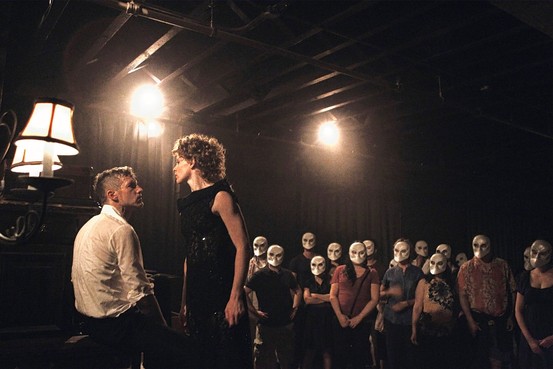
Alas, Sleep No More begins, really, with a cocktail bar, complete with thematic drinks – given that the show is an allusion to Shakespeare’s Macbeth, the drinks have names like Season of the Witch or Summer Coven. The cocktails cost as much as they would in any Manhattan bar. Oh, and, of course, one exits through the gift shop. These aspects are not tangential to the show, they are part of it. They are also part of the obligatory move of “diversifying income,” revenue streams which were added on the go as the show saw success. I’m sorry to say that to me, Sleep No More reminded me of a theme park, or, more specifically, a haunted house within that theme park – I’m thinking here of the twentieth century American-style theme parks, which are a kind of wholly commercial immersive experience. I do not think this is solely because of the transactions one is invited to make before and after the show. While I do believe that the economics of any work of art may determine its content, good work can be materially sustained in all sorts of different ways. On the other hand, it is my personal observation that work that fails often does so in a way that reflects its material aspects: a bad show that is wholly sustained through corporate-style funding committees will tend to “play a theme” or try and fail to execute a high-concept idea, because it is themes and interesting pitches which such funding bodies respond to. A work that is funded more like a commercial venture is, if it fails, likely to feel shallow, like a bad Hollywood movie or Disney theme park (with the caveat that some people actually enjoy those – very few enjoy poor executions of high-concept ideas or the playing of themes.)
Location, or venue, is an important practical, and thus economic, consideration for any live show. Immersive experiences face a bit of a conundrum, though, as there are no dedicated spaces for such works, the way there are for other types of live shows. So, anyone putting on an immersive show needs to get creative; the shows reviewed here used a former hotel, a historical villa, and a repurposed residential building, respectively.
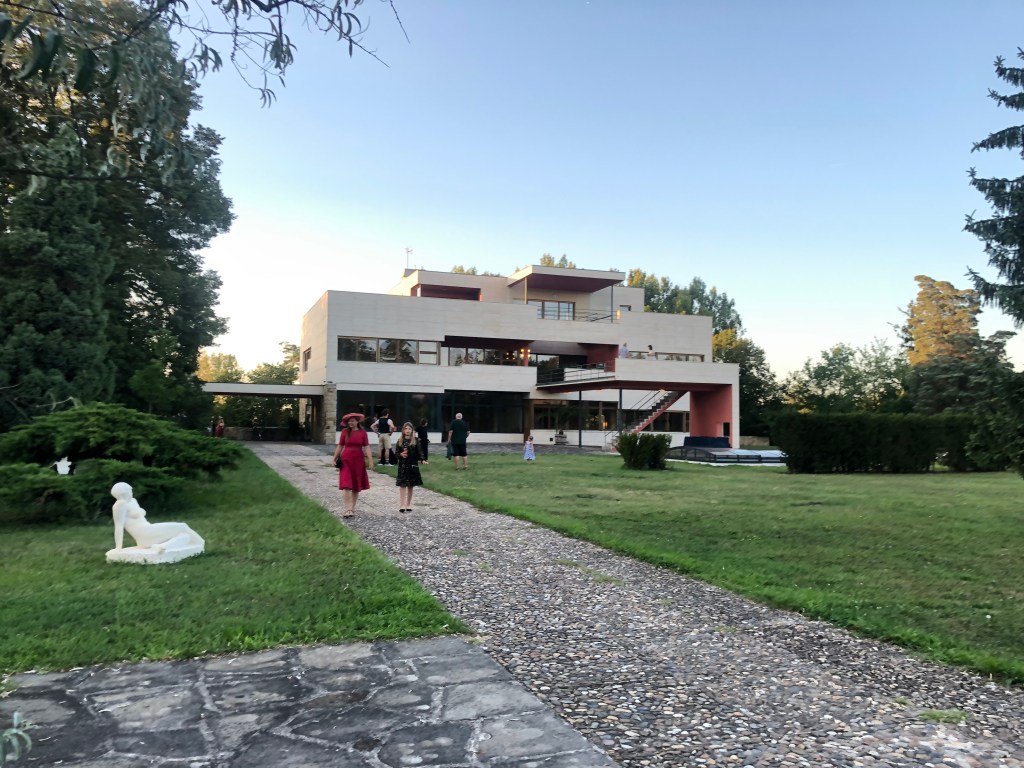
Finding a venue seemed to be the biggest hurdle for the creators of Sleep No More – they ended up putting millions into the renovation of an old hotel. The six stories of the former McKittrick hotel, and the scenography within, are a character (perhaps the main character) of Sleep No More. Malvína (2023), the second immersive narrative work I ever attended, was created for the historical Volmanova Vila in Čelákovice, near Prague, Czech Republic, and wove the history of the villa into the narrative. The funding for the show partially came from the villa itself, the managers of which have fashioned the space into a music venue, a short-term rental, and a historical monument with guided tours. The symbiosis between places that want exposure and immersive narrative experiences makes sense. Malvína calls itself site-specific immersive theatre, and “site-specific” might indeed be a large sub-category of live immersive narrative works and, as Malvína shows, may be a funding angle which can emerge early on in the creative process or may even initiate it. I suppose there is also a distinction to be drawn between “funding” and “partnership”; I cannot tell which Volmanova Vila granted. A venue, like the villa, might merely grant access to rehearse for free and cover certain costs or aspects of running the show (refreshments, perhaps, which the villa, for example, seemed repurposed to provide through a little vending window). This is as good as funding a show, however, as anyone who has ever tried to put together a live performance knows that using a space for free can more than halve your budget. There are creative risks to this location-show partnership model, too, depending on the terms. While Sleep No More felt like a theme park, Malvína sometimes felt like an advertisement for a slick living space – finished in 1939, the Volmanova Vila is old enough to be historical, but young enough to feel like sellable real estate.
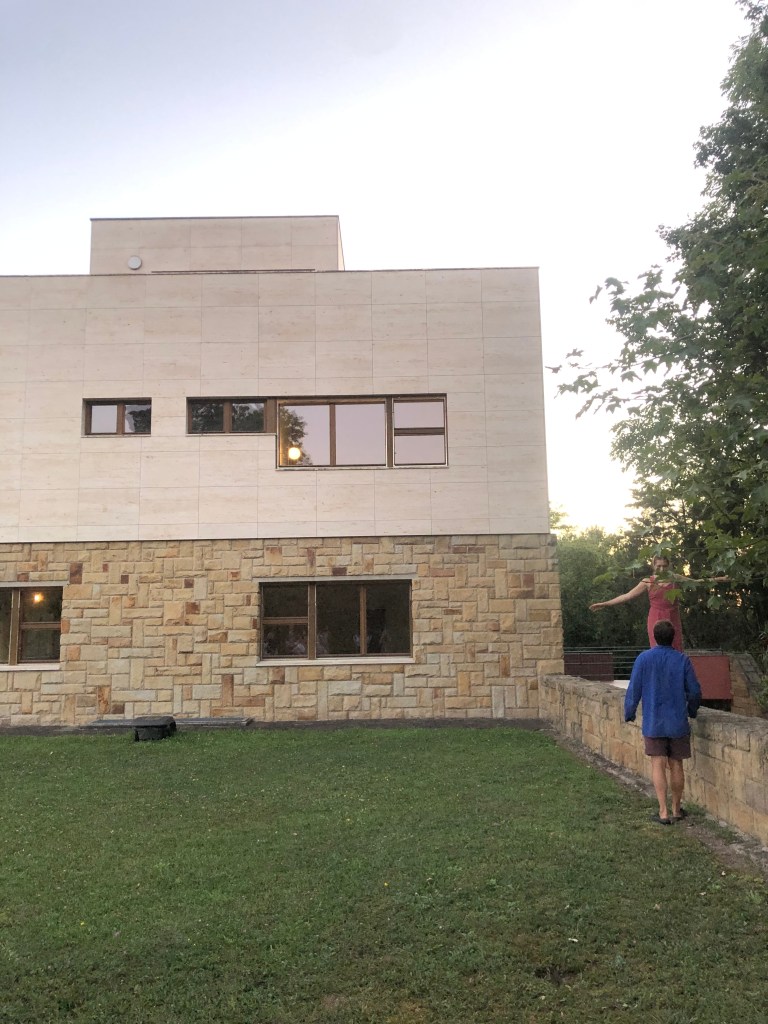
On the nearly empty train back from attending Malvína in Čelákovice, I spoke with its creative team, which overlaps with the team of Musí se žít (2022), and from our conversation I got the sense that Musí se žít was, in some ways, inspired by Sleep No More. Or, more likely, the Pomezí theatre company as such is inspired by it. When I mentioned I had attended Sleep No More, co-writer, director, and founder of the company, Lukáš Brychta, spoke with a kind of reverence about it, or at least that’s the sense I got. I’ve come to realize that what Sleep No More has done more than anything is give the immersive theatre format as such a bit of a boost. The Pomezí company seems to now be a leader in the immersive theatre niche in the Czech Republic. Their numerous shows are often sold out. The company launched in 2014, just a few years after Sleep No More brought this “new art form,” as the producer Jonathan Hochwald called it in that 2014 Forbes article, from its gestational phase in the UK to the bigtime in New York (the editor of this publication pointed out that the 1981 show Tamara is an early instance of immersive theatre which actually premiered in Toronto, Canada, and then traveled around, enjoying long runs in Los Angeles and New York, with the latest revival in 2014 in Pennsylvania; the UK-based Punchdrunk company, founded in 2000, perhaps picked up the baton from such earlier shows, rather than inventing a “new artform.” Of course, Punchdrunk and its funders benefit from claiming to be inventing something; “innovation” is the most overused corporate word for a reason.) I think Mr. Brychta must have reverence for the show’s major-Broadway-show-level wealth, and the fact that that wealth helped spread the word about this niche format and thus perhaps empowered smaller companies to experiment with it themselves, than for its artistic merit (I’ll never know since I wrote to the company to tell them, with utter sincerity, that I thought Musí se žít was a great show and never got a response). Unlike Sleep No More, Musí se žít, tells a real, original, story, offers moments of good theatre, not just a mood – and all that with a fraction of the space and budget (and at a fraction of the ticket price.) The similarities between Musí se žít and Sleep No More are superficial, but palpable – the dim lighting, certain set pieces, the constant mood music blaring from speakers. There was also a bar – but rather than being a place you were ushered in to wait and spend money, it was part of the show. In a Czech twist, beer cans were dispersed throughout the playing space, and spectators were invited, through signs, to drop cash into baskets, unmonitored for accuracy or theft.
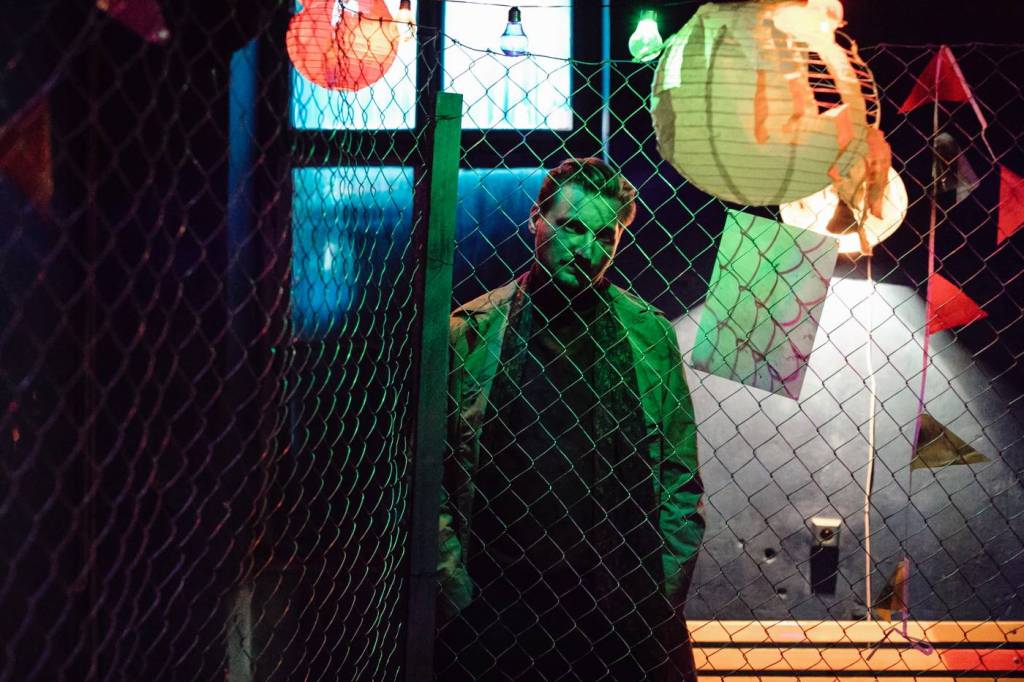
A VR installation is a kind of semi-live experience in which only the spectator forms the “live” aspect of a show. While in certain respects facing some of the same concerns as the immersive theatre pieces reviewed here, there seem to be some specific considerations to deal with, ones having to do with the accessibility of the technology. In the case of Songs for a Passerby (2023) there seemed to be only two VR headsets, one for each ca. 3-by-3-meter mat which delineated the VR world (there may have been other spaces with more headsets but, even so, the amount of visitors they could take at a time for each 30-minute experience was exceedingly small for a cultural institution like Bozar in a major European city like Brussels). Visitors had to reserve a spot in advance and, given the minute audience batches, tickets seemed impossible to get. In fact, I was unable to reserve a ticket and only snuck in by arriving in person and being lucky enough to take the place of a no-show. By an absurdly Franco-Belgian loophole, I did not pay for my ticket, because the computer system didn’t allow the sale of a ticket once it had already been sold, leaving no contingency for no-shows which, according to the exasperated ushers, were pretty common. In fact, I suspect I was allowed in only thanks to the good will of the usher, who may have been forbidden to let people in under such circumstances. I share this simply because the exclusivity of a technology like VR seems to heighten the stakes of access; it’s not just a seat that you’re vying for, it’s a whole VR set-up which can cost upward of 1,000 Euros per head, that is, for a single audience member at any given time. This more than makes up for the advantage of the “sets” having no material cost outside of design and the actors, if there are any, being recorded. There is a preciousness and exclusivity to (more or less) cutting edge technologies like VR, because they have an air of mystery about them. There are few true tech generalists; the hardware/software divide alone is stark. While a scenographer would be able to find the materials and probably would themselves have the skills to fix a broken set, a VR designer would likely not be able to open a headset and fix or modify it – very few people would, in fact, and this technical ineptitude is, actively or not, supported by tech companies since it helps them maintain economic consolidation. Imagine if the technicians in a Baroque theatre did not actually know how the chariot-and-pole scene change mechanism worked, only how to use it, and every time one of them got jammed, they would have to send it back to the maker to get a replacement. Now add to this the fact that it’s not just performers and technicians interacting with this set – in the case of VR headsets, it is actually the audience. A lot of economic relevance today depends on something that might be called technological secrecy. My experience of essentially getting snuck into this VR show is just a small manifestation of this preciousness around technology, but one I would care about as a creator of works which employ it, since it has to do with that ever-relevant theme of accessibility.
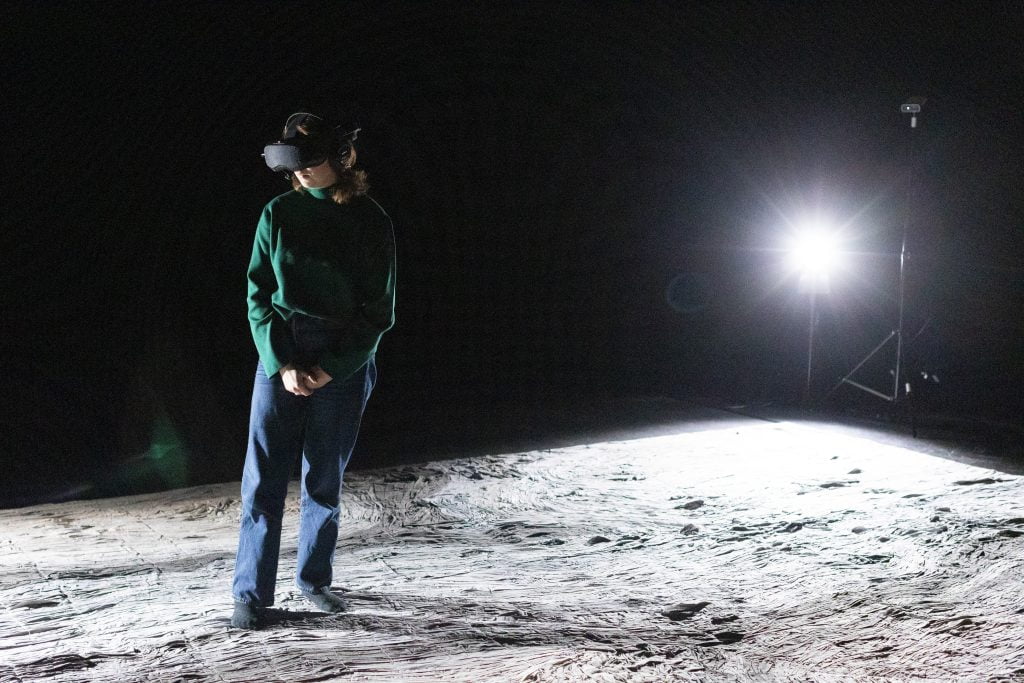
And then there is the nature of the technology which mediates the world of Songs for a Passerby. Having read the memoir of Jeron Lanier, the father of virtual reality (The Dawn of the New Everything, 2023), I was worried about nausea and dizziness, a common experience of VR headset users which plagued the developers of VR for so long it seemed insurmountable. Someone must have figured something out, however, as even I, who to this day gets nauseous in cars, felt no nausea or lack of balance at all. The headset actually allowed suspension of disbelief to a greater extent than I would have thought, and perhaps to a greater extent than the live theatre immersive shows I’ve attended. Perhaps this is because the total elimination of the physical world makes it easier to become immersed.
Directing the Audience
Immersive narrative works present a unique problem for creators to solve: How does one keep the audience within the container of the show? That is, how does one direct the audience, elegantly train them like they are an actor about to do an improvisation, without being obtrusive?
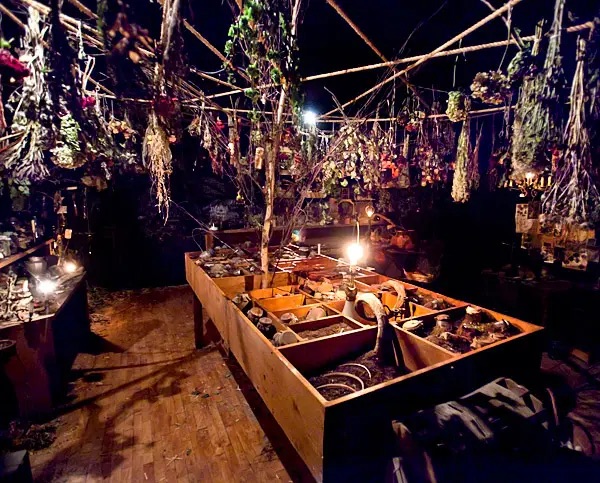
From the start, the approach of Sleep No More, in true American fashion, is to sanitize everything from the start: You have to turn in your coats and bags and either hand your phone in or put it in a lockbox to wear like a purse. You are given a mask to wear – a kind of stripped-down Venetian type of white plastic. Without your phone and bag (you are told to take your wallet, of course) and primed to wear a mask, you are already stripped of a bit of your agency and identity. You are given a playing card before you pass through a tunnel into the cocktail bar, where a vaguely “in-character” woman greets you as you walk in. What character is she? Unclear. But she wears a not-of-this-era costume and her diction belonged on a theatre stage. Her function is utterly practical, however: She tells you to wait in the bar until your card is called and encourages you to buy a cocktail in the meantime. She then calls out the playing cards at time-it-takes-to-order-and-drink-a-cocktail intervals (while refreshments are standard theatre fare, it does feel strange to make a concerted effort to get your freely-roaming audience tipsy before the show) and as you gather with a small group in a vestibule at the bottom of a set of industrial stairs, your host tells you to don your mask and to not utter one word from this point on. In driving this point home, she is aided by an usher who plays “bad cop” about this issue, shouting any stray mumbles down like she’s wrangling a group of schoolchildren. After being lectured about staying quiet, you are let out into the actual performance space to explore six stories of the former McKittrick Hotel. I do not remember six stories being available, however. I do remember ushers standing at a mezzanine, not allowing people to go further up. There were also ushers throughout the performance who stand in the way of doors behind which too many people have gathered (so as not to break fire regulations, perhaps). I assume there are masked individuals hidden among the audience, who are there to act as bouncers and bodyguards in case of need. I do not remember when, or if, this is made clear but one is allowed to touch objects and interact with the environment; some rooms seem to be designed for this purpose, with filled drawers, vials which can be moved around, stacks of notes that can be read. It is not allowed to impede performers in their tasks, however, and I did not actually see any interaction between performers and the audience, unless one counts the runners who made it a project to pursue particular characters throughout the space. Performers, indeed, functioned as another type of audience guides, moving throughout the levels of the hotel, acting out their own continuous stories, followed at a clip up and down stairwells by spectators up and down stairwells. This is also how the show could end – when all characters converged in a single space, bringing most of the audience with them.
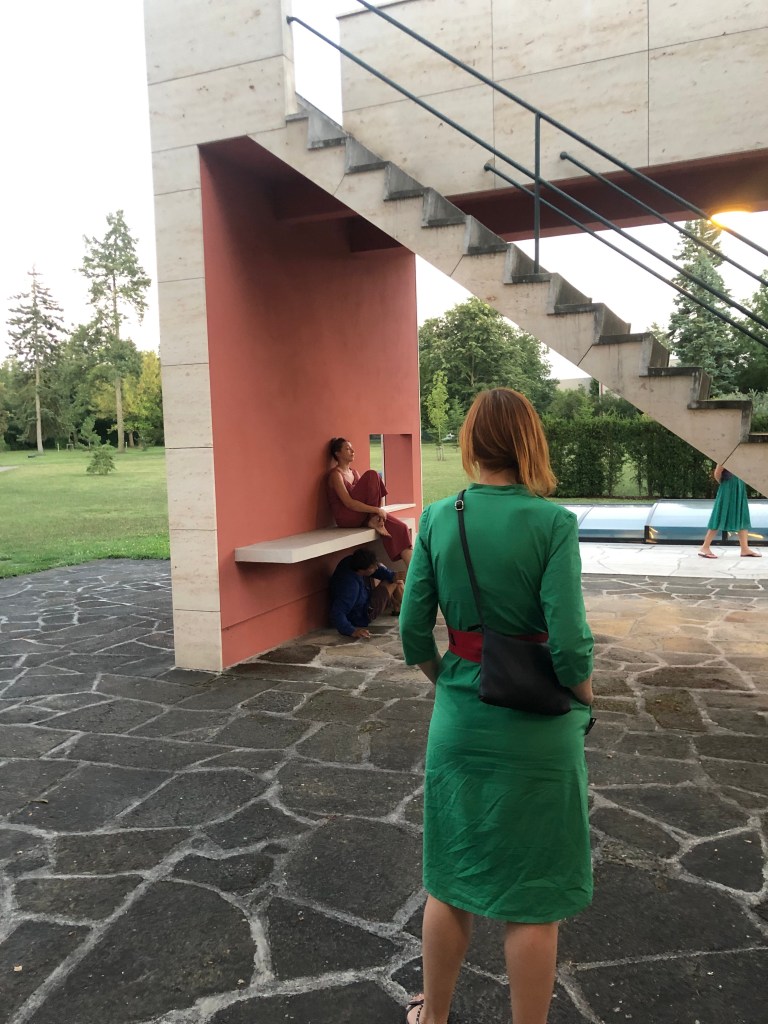
The site-specific immersive show Malvína involves explicit guides, at least at first. The audience gathers at a gate in front of the villa and, before the show starts, is divided, randomly, into three groups, which are each taken by one actor to different far reaches of the expansive property around the villa. The actors (and I assume this was the case for all of the groups, though I can’t be sure) are both in character, mentioning their wants and frustrations and saying things about other characters, and simultaneously act as tour guides to the villa, rattling off the occasional historical fact. They seem to be instructed to interact with the audience, comment on them, ask them questions. This breaks the fourth wall, something which does not happen in the other works in this review, except in some isolated scenes in Musí se žít which not every audience member experiences and, I’ve heard, in Sleep No More, also on isolated occasions; this is interesting, given the naturally interactive possibilities of immersive theatre. The problem is, perhaps, that the moment actors start interacting with an audience that is also free to roam, you could end up with an utterly uncontrollable beast of a show, which could go in way too many directions. That is why it is safer to have the spectator be diegetically invisible. In Malvína, the interactive part of the show is contained to the beginning and is clearly framed as a guided tour, a dramatic situation we, as an audience, can easily follow, and which allows us to feel fairly secure about our task within the action. This is a strategy that avoids what I can only call “spillage” – a breaking of the form because of too many variables. A tour also has a natural end point, once the villa has been shown. After this, Malvína reverts to a format closer to Sleep No More and Musí se žít, in which the spectators, for the most part, do not exist to the characters.
While Sleep No More is as in-control of its audience as it can be, given the live immersive format, Musí se žít exerts the least control, or at least this was my experience. The audience can put its bags and coats on some shelves downstairs, but it’s not strictly monitored whether they do. Phones are not allowed, under the penalty that “the show will stop and not continue” should they be used, but they aren’t taken away. The ushers explain at the beginning that we are allowed to roam freely and there are some security-guard types in the front but other than this, it’s a free for all. The restrictions on speaking are only common-sense ones (don’t speak so loudly you can’t hear the actors) and aren’t really explicitly stated, from what I recall, or certainly don’t constitute a full restriction, so as to allow for some back and forth between actors and audience members. There was even a baby – yes, someone brought a baby to this show, though the rules state that it’s restricted for people under the age of 15. It might as well have been a public park. Given that one does not step twice into the same immersive theatre show, this may have just been an odd night or the creativity of memory. In any case, this level of freedom, which is to say trust, is harder to imagine with a big-budget venture like Sleep No More – or it’s a cultural issue in a feedback loop with the economic one.
The VR experience, like Songs for a Passerby, presents a whole other level of control; places outside of where the creator wants you to go don’t exist, nothing can be touched, there are no performers to harass, and the eye can be directed in a semi-cinematic manner. If you do stray, there is an usher to guide you back, whom you can’t see because this person does not exist diegetically and, therefore, visually (I shudder to think what it’s like to be touched by someone in the real world while in VR.) The usher walks you through the process before you don the VR glasses – you take off your shoes and are asked to stay on the mat throughout the performance and also told something along the lines of “follow the light and avoid the darkness.” The more poetic nature of this statement works as a kind of invitation into the story while also serving a practical function, like the playing cards and “in character” usher of Sleep No More. For most of Songs for a Passerby, you are guided from scene to scene by a dog – once a scene is over, you hear a little pant from the direction you are supposed to go which alerts you to the fact that you can now follow the dog to the next scene. The virtual space is in the shape of a spiral going upwards, which allows you to stay more or less in place (walking in a circle) while feeling like you are journeying a respectable distance. What I was supposed to do within the experience felt intuitive and organic to the work, which I’m sure was a goal the creators must have discussed a great deal. As such, the aesthetic of the work does feel a little video-game-like at times, however –for the story to go on you must move to the next “level” and there is only one direction to go at any given time.
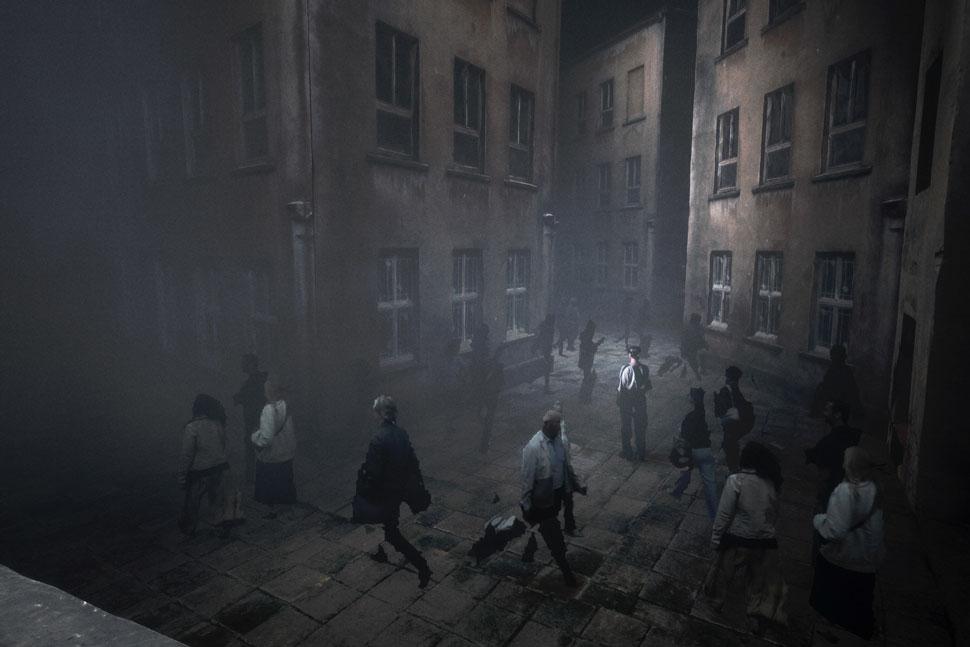
Looking back at Songs for a Passerby, it’s interesting that I never even tried to, say, walk past the tower lookout, where I would, according to the logic of the VR, have to fall downward – I cannot report on how the VR would have behaved had I done that, but whatever it would have done would likely take me out of the fictional dream, unless there were some hidden aspects of the experience I was too polite to explore. In any case, audience compliance is a key aspect of a VR show; the fictional dream is held together by the spectator’s willingness to make-believe that the walls and paths really exist. In a way, all live performance depends on a contract with the audience about how it is to behave, but it feels particularly palpable in a VR world which the spectator knows isn’t material. This is paradoxical, given the aforementioned subjectively fuller immersion of VR, compared to immersive theatre.
Narrative
So, what are the shows actually about?
All of them, for reasons that have to do with the nature of the format, either are abstract compared to a truly narrative show or feel that way because of a kind of reverse-cubism – rather than seeing multiple sides at once, you are only allowed to see one side, and then only a fragment, of a many-sided story. Sometimes this means you do not have enough information to construct a story at all.
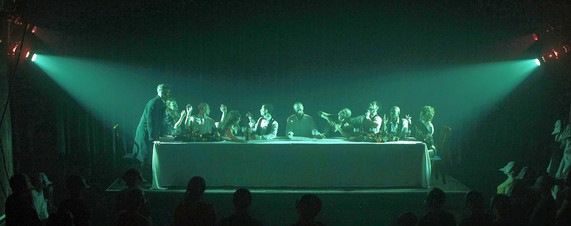
To say that Sleep No More is based on Shakespeare’s Macbeth is misleading, as it could be taken to mean that it recounts the story of the play. The creators claim to do this on the website, but the reverse-cubism makes this intention irrelevant to most visitors. Instead, the piece feels more like a mood board inspired by Macbeth along with some vague cinematic references. Before attending, I had heard tell of cameos by famous actors (I think I remember the name Glenn Close, at one point; I now wonder whether this was part of a deceptive whisper campaign on the part of promoters) and so was disappointed to find that there was no dialogue in the show, at least not often enough for it to be inevitable that one would run into it. The show was cast with dancers, and any semblance of story pantomimed. The space is vast enough and the performers few enough that one can spend a lot of time in a suspended state, exploring elaborate, always dimly lit, sets with various mood music blasting from speakers. The sets often hint at some decipherable secret, certain objects manage, somehow, to look like clues in some big mystery, but it is a mystery that might as well be an empty box. The only scene I remember that I could connect with Macbeth was one between a male and female dancer who could have represented the central couple of the story, inasmuch as the dance expressed some kind of power struggle between them. Besides this, the only scenes I encountered were a man going to pray in a small chapel, a woman who seemed to be slinking around doing bad things to other characters, a longer scene in a 1920s-looking hotel lobby, which involved some pretty abstract dancing by the receptionist and a pregnant woman getting poisoned by the aforementioned scheming lady, and then it all converged, through the simple method of all performers making their way to one point and bringing the spectators with them, in a basement room, where a kind of last supper took place, all the characters moving in impressively convincing slow motion on one side of a banquet table, and then abruptly ended with a hyper-realistic hanging (there were spontaneous gasps from the spectators), which concluded that cycle of the show (it seemed they moved through the same cycle several times a night, making it a multi-show performance, really.)
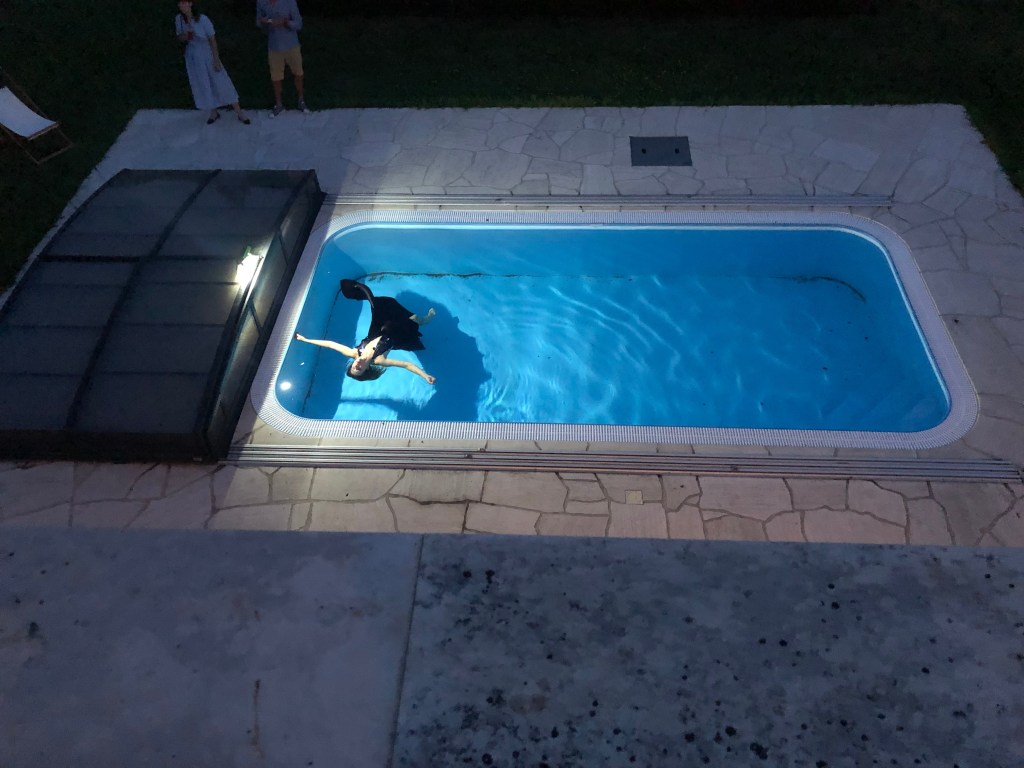
Malvína also employed the strategy of characters starting off in separate places (first in the position of tour guides) and then converging with each other at the end (from a certain point onward no longer seeing the audience, becoming absorbed only in the diegetic world of the story), until a climactic scene at the end, also a death, it seemed, this time by drowning. That seems to be one “shape” an immersive narrative work can take – converging trickles, the sense of resolution being the result of action that used to be happening simultaneously in different places converging in one place. During the beginning tour-guide section, I was placed with the female ingénue who made some very strange choices, acting-wise, which may have had to do with trying to go for some kind of hyper-real awkwardness (I’ve seen this actress, Marie Machová, in two shows with the Lachende Bestien ensemble and I thought she did well in this Brechtian, self-aware format, but perhaps realism isn’t her strong suit; I’d be curious to know if “acting like we’re not acting” was, indeed, what the tour guide section of the show was envisioned to be). I confess that I did not fully grasp the story, though it was, as the co-writer and director Lukáš Brychta said on the train back, a “simple form” compared to both Musí se žít and Sleep No More. The cast consists of two men and one woman. It’s a love triangle set in the 1930s, when the villa was built. The woman, the ingénue, ends up dead in the pool at the end. Sometimes, that’s all you need to experience a story, I guess, just like cartoonists need just a few lines to draw a face.
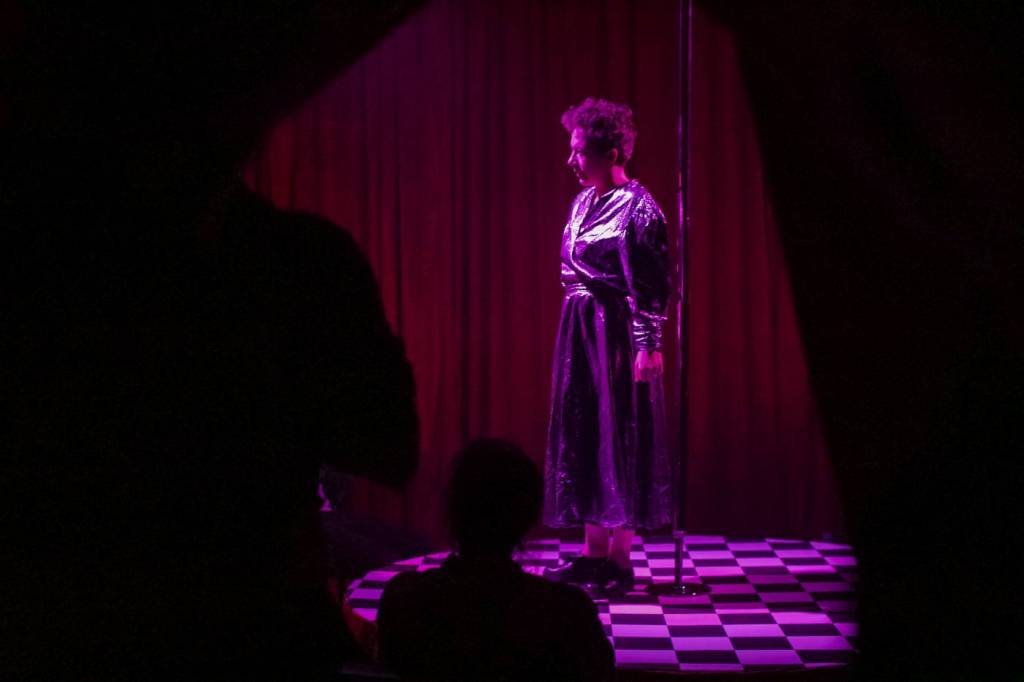
Musí se žít offered the most theatrically satisfying, intricate scenes of the shows reviewed here. The scenes were not just “mood” but employed actual dialogue, actual conflict, with actually good acting. I have a strange relationship with evaluating acting – it’s something that strikes me from the smallest action a performer might take, and it’s unquantifiable. At one point, I turned a corner and saw Kateřina Neznalová getting out of a car and shutting the door – that action alone made me feel I was in the presence of real theatre. There is a meta-aspect to Musí se žít, which was mainly conveyed, during my experience, at least, by a character played by Kryštof Bartoš who called himself a writer and gave a little interactive speech to a group of us about the play as a play, which ended up getting unruly because of some spectators climbing into a trap door, but for the most part Musí se žít has the characters exist only in the diegetic world of the story, to the point of sitting on top of spectators who sit in their chairs. The title, which translates to “One must live”, is apparently a reference to Chekhov, echoing a line at the end of Three Sisters. The show is, as reviewers have pointed out, more Lynchian, though, than Chekhovian. The entire space is bookended by two establishments: the Doppler Bar and, on the other end, the Ganger strip club. The idea of a doppelganger does also appear in the story, but in rather vaguely Lynchian ways – one character might be an impersonator of a famous singer, or she may actually be her. The whole show is full of clues that never go anywhere but this shallowness is combined with relational and emotional intricacy on the scene level. When it comes to how it handles the immersive narrative work format in particular, I agree with a reviewer Lukáš Dubský who writes that every scene you encounter is written and directed such that it feels pivotal to the story, even as one must imagine that other, similarly pivotal-seeming, scenes are happening at the same time. Rather than take the approach of both Sleep No More and Malvína and forcing a climax by having the story end in one place, by bringing the characters to one place, the show ends simultaneously in more than one place, which in and of itself sets it above the other two examples in terms of complexity.
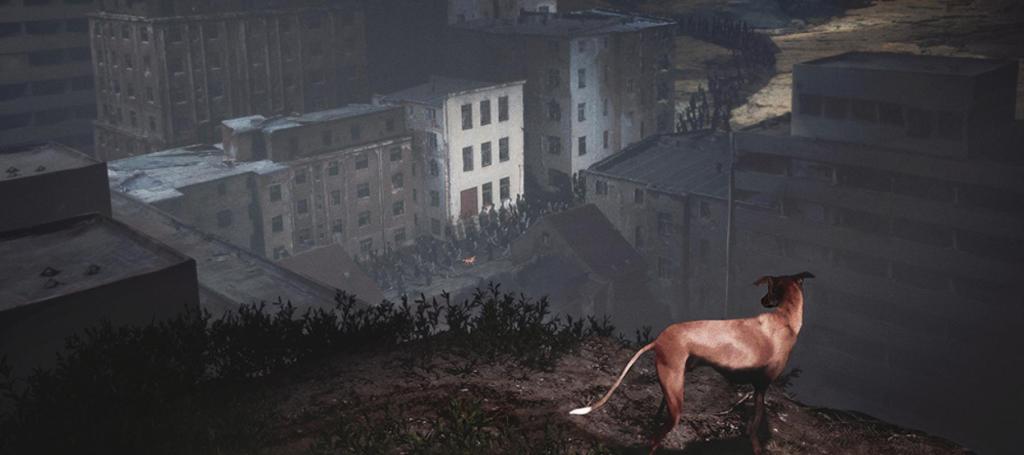
Songs for a Passerby is, unlike the immersive theatre experiences reviewed here, unidirectional. There is just one storyline, in which the spectators merely change the pacing by moving more or less quickly from space to space (though even that is to some extent determined, as it seems you cannot move to the next “level” until the dog invites you to). Most of the “scenes” are mere situations. You might gaze out for a while over a street on which ghostly, mid-century looking figures are walking past, all in one direction. You might find yourself next to a dead horse. You might see that same dead horse then lying in a dark alleyway you now see from above, or you might see yourself standing in the distance, facing the other way in a procession. Even the closest thing to a scene – which takes us out of the spiral tower into a train vestibule, first inside and then looking in from the outside – is more like a situation in that you walk past passengers and hear snippets of what they’re thinking, but there is no development. The climax, logically, is when you get to the top of the tower. There, something happens which is meant to be the point d’orgue of the piece– you meet yourself, that is, a live projection of yourself, and eventually you stand with yourself face-to-face. Of course, “you” are wearing a headset, which kills the mood a bit. It does present an interesting phenomenological problem, which is perhaps intended on the part of the creators: You do not experience “you” from the outside, so this person you see, this glitchy projection, isn’t you, not in the true sense of the word, since you are your experience rather than your exterior. To tie in another format: The novel, or more broadly, written narrative, allows us to conjure an inner experience like “meeting yourself” in a way visual media, I believe, cannot, since, contrary to the dreams of the father of VR, Jaron Lanier, the VR experience is still primarily a visual one. Making it more than that is the next frontier, pursued in Silicon Valley since the 80s, but still mostly out of reach.
Aesthetics
This section is short because if it were not, it would be its own essay.
Since following the light is such a big aspect of the audience task in Songs for a Passerby, there has to be a lot of darkness. This pre-determines the visual aesthetic as somber and nighttime-like. Interestingly, Sleep No More and Musí se žít also chose the dark aesthetic. This feels a bit manipulative – there’s a reason hip cocktail bars tend to choose the exact same kind of lighting, though as the editor of this publication pointed out to me, it was also Wagner’s move when he dimmed the lights in the house for his operas. The exception was Malvína, which started outside in daylight and ended after dark and, even then, went for a more brightly lit look, probably to flatter the contours of the villa. I worry that some of the awkwardness of Malvína in the beginning had to do with the unforgiveness of daylight and the absence of constant mood music, present throughout all the other works. I think in the case of Songs for a Passerby the music was meant to be more than mood music; the “song” was present through choral pieces throughout and in some promotional material the work was referred to as an “opera,” but I would say that the function that music played in it was the same as in the more theatrically focused Sleep No More and Musí se žít.
Closing Thoughts
There might be a parallel between my reaction to these immersive theatre experiences and questions surrounding the nature of opera, my area of study. Opera is also a format that draws attention to itself as a format. The peculiarity of all characters singing at all times certainly didn’t escape critique throughout its history. It may be that, like someone looking for full mimesis in opera, I’m searching for the fictional dream in a format that by its nature rejects it through the very aspect of it which roots it in reality (note: not realism but actual reality), that is, the roaming of the live audience (a group of real people who are not part of the fictional world, who make choices about where to go.)
What to some spectators might function as limitation, may in fact hold the key to the power of a format. Maude Pouradier philosophized continuous singing within opera in her necessary (and, I think, undervalued, within opera studies) monograph Parler en chantant: une philosophie de l’opéra (2023):
« Quand un chanteur entonne un air, c’est à moi qu’il s’adresse, et les bornes de la représentation vacillent. C’est ce qui fait que l’opéra a une puissance d’incarnation que le théâtre ou le cinéma n’ont pas. Il ne s’agit pas de dire que les chanteurs deviennent les personnages, mais que je suis impliquée dans la fiction opératique par l’énonciation chantante. Ce trouble dans la représentation est un plaisir caractéristique de l’expérience opératique, qui fait pleinement partie de la construction fictionnelle, d’où la prégnance du sacré et du politique à l’opéra. » (p. 342)
“When singers perform arias, they address themselves to me directly causing the limits of representation to vacillate. This is what gives opera its power of incarnation which theatre or cinema lack. This is not to say that singers become their characters, but that I, as the spectator, am implicated in the operatic fiction by the sung utterance. This disruption of the representation is a pleasure characteristic of the operatic experience, one which is clearly part of the fictional construct, which is, in turn, what gives the sacred and political in opera its pertinence.”
Pouradier speaks of another kind of immersion, the immersion of an audience through the operatic peculiarity of continuous singing. Might we articulate a similar philosophy for the type of immersive theatre format defined by a roaming audience? While Pouradier wrote her monograph as a self-aware “lyricomane,” I am not (quite) an “immersive theatre fanatic” but I can intuit that the “pleasure” of this sort of immersive theatre lies in that friction between real and unreal when a live audience roams a fictional world.
| Ema Katrovas (CZ/US) is a vocal performer, researcher, translator, and writer. She is currently writing a thesis on “poor opera” at GLAREAN, the European Doctoral College for Musical Interpretation and Artistic Research. |
 Theorema
Leave a comment