
by Auli Särkiö
HYPERDRIVE INN
Horsefly Games, 2024Concept and development: Juho Kuorikoski
Additional visuals: Henri Tervapuro
Music and sound design: Juhana Lehtiniemi
Imagine a rotating stage with an infinite number of sets, each with its distinct atmosphere and characters. A theatre space as Bertolt Brecht could have dreamt it, constantly displaying its own theatricality, its mutely gesturing figures like paper-cut dolls. But instead of just witnessing this strange spectacle you have to create it yourself by solving your way through locked rooms: with each solved riddle, you get another turn of the stage, another set of rooms revealed.
This is what happens in the Finnish puzzle adventure game Hyperdrive Inn, published in late 2024 by the Ostrobothnia-based Horsefly studio headed by Juho Kuorikoski. A satiric over-the-top dystopia and an homage to adventure games of the 80s and 90s, Hyperdrive Inn offers the player the identity of a young woman called Aino – somewhat Ostrobothnian in her bold and badass temperament – who sets on an Alice in Wonderland-like quest down a rabbit hole of deepest absurdity. There is a fair amount of Kafkaesque red tape hell and hearty satire of office cultures with their endless protocols, nonsense discourses, and impossible tech systems, let alone morbid commentary on aggressive capitalism, superpower arms race, conspiracy theories and so on. (For an example of gameplay, see below.)
The dystopian scenario is sketched out with just a few strokes, almost poetically: a science experiment gone wrong, a giant corporation taking control of the universe and making every living being a disposable resource with no rights whatsoever. Set in an infinite hotel created by a singularity-like super machine able to bend time and space, Hyperdrive Inn makes the playable space its own metaphor. After all, games create infinite worlds where everything is possible. The hyperdrive machine, created by Aino’s elusive father, could have worked wonders but ended up in wrong hands. In addition to being totally controlled by the Mephistophelian corporation, the universe is also on the verge of collapse as the warped time-space keeps engulfing everything and turning it into a nightmarish mirror world.
This vision is contrasted by soft visuals assembled from actual textiles: cross stitch lettering, quilt collages and checkered designs, created with scanned fabric samples from a local furniture company. For the dialogue sections, additional picture book-style characters were created by Henri Tervapuro.
The narrative is driven by absurd iterations and surprising encounters, full of intertextual nods ranging from adventure game canon to pop culture in general. The hotel is life itself and includes everything: a train’s buffet car, two rivalling circuses, a self-storage unit, a nuclear plant, a meeting of a secret society, a costume party turned revolutionary convention, and so on. You may find yourself in the stomach of a whale, in a retirement home on the back of a giant cow (taught to eat the remains of the deceased inhabitants), or even in an Ostrobothnian village with characters speaking in plain local dialect – a nice puzzle for non-Finnish speakers, and a hilarious laugh for Finns. Thanks to randomized level generation you have literally no idea where you’ll end up next, though some levels may be repeated in the course of different play-throughs.
Human characters are often named after their professions or roles (‘Ticket Master’, ‘Hipster’), whereas animals and robots have unique identities: there’s an owl called Fredric, a mutated killer pig called Toby ’Lazerboar’ Baedeker, and robots called Spencer, Greg, and Tanner. Sometimes you roll with laughter, sometimes experience genuine unease. An earlier game by Horsefly, a free-to-play mobile game called Lydia (2017), developed for the Finnish alcohol retailing monopoly Alko, was specifically designed to make you feel bad as it portrayed alcoholism through the eyes of a child and discussed abuse and trauma.
Hyperdrive Inn, too, deals with childhood trauma. Underneath the myriad ‘hotel rooms’ runs a story of Aino’s relationship with her father and their attempt to reconcile. As completing the game takes some 10 to 15 hours through a vast selection of levels, it has room for subtle exploration of deeper themes from different perspectives. In line with its namesake time-machine, Hyperdrive Inn has several timelines and multiple endings. One option (the happiest?) has Aino playing video games with her father in a cosmic limbo. Infinity is impossible, there is no such thing as an infinite space or infinite growth, is the final message of the man who invented the fatal machine.
***
Hyperdrive Inn relies on a nostalgic explore-and-solve mechanism instead of a more inventive game-design, but as the adventure goes on, the self-conscious referencing of an earlier gaming culture – one predating the now prevalent immersive 3D graphics – becomes a mechanism of its own. A good game plays you as you play it, and the endlessly imaginative Hyperdrive Inn is constantly playing around with the player’s expectations.
This works also within the puzzle-solving: some of them are very tricky, others quite easy, some purely logical, others need a whole lot of external knowledge (puzzle-solving in the era of AI). Sometimes the player is tricked into studying hexadecimals or ancient runes when the solution is actually quite simple. Alongside classic logic-based puzzles there are some including intricate word-play, and rooms are riddled with notes and user manuals for machines and computers of various kinds. Overall, Hyperdrive Inn is heavy with words, and dialogues are like blabbering collages of different literary and textual styles. Though I found this annoying at first, after a while the dialogues constantly on the edge of banality started to feel like a distinct part of the absurd aesthetics.
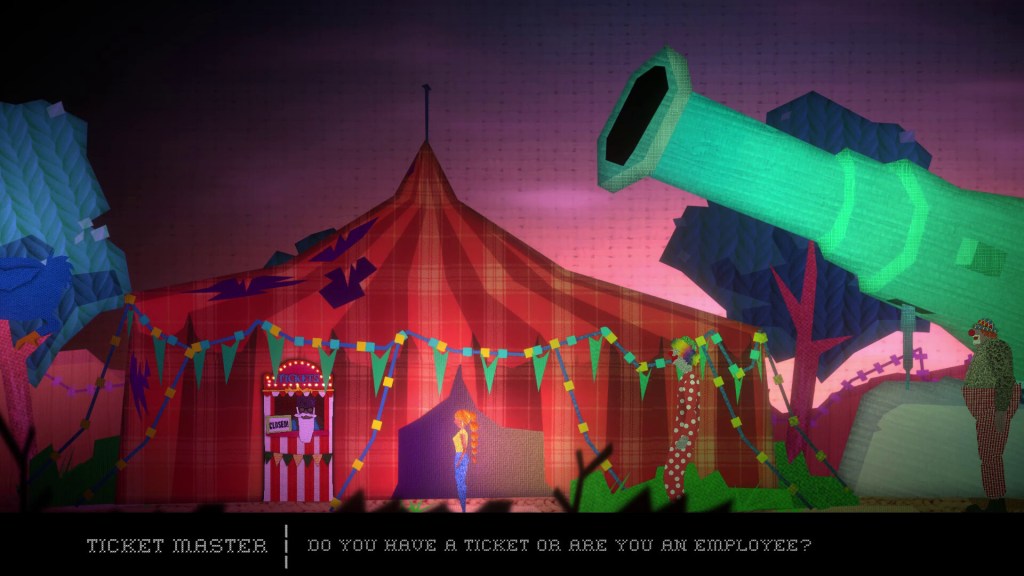
In the vein of arcade games and ancient consoles – often referenced inside the game – the user interface is very simple, requiring only a couple of keys as opposed to the mouse-driven point-and-click-interface of 2000s and 2010s puzzle games. Limited character control, 2D design, and dense textuality strongly recreate the aesthetics of early adventure games like The Secret of Monkey Island (1990) and the King’s Quest series (1984–1998) and hearken back to a time before first-person-shooters when puzzle adventures were the dominating genre.
More than just paying homage to its roots, Hyperdrive Inn, with its playful intertextuality, engages in an almost meta-level discussion with the history of the genre (starting with text adventures like Zork) and the Finnish game canon, from the legendary Snake (1998) in Nokia’s early mobile phones to Angry Birds (Rovio, 2009). Aino is clearly an avid retro gamer herself, and encounters several arcade-like mini-games on her path. There’s also a hint at the upcoming arcade shooter Stratogun by Horsefly.
References abound to the gaming industry in general, from esports to startup culture; there’s a dev trying to make a sequel to the Finnish 1986 Commodore-game Uuno Turhapuro Moves to the Countryside, and an investor’s meeting for a new mobile game called Mad Cowz. This kind of wry self-irony is quite typical for Finnish indie games – one of the most celebrated being My Summer Car, an absurd and extremely challenging simulation-survival game released in 2016 where the player is tasked with assembling a Datsun car in a Finnish village in the 90s while tackling thirst, hunger, exhaustion and other dangers. It has even been credited to creating its own subgenre, avidly emulated around the world.
As Hyperdrive Inn is composed of rooms, it quite literally references room escape games, too – a video game genre typical of the 90s and early 2000s and later transformed into the now popular physical escape rooms. In order to proceed, the player must explore the given space and combine the elements available to crack the answer that opens an exit. Like in Georges Perec’s Oulipo novel Life. A User’s Manual (1978) where game-like techniques and constraints are used to tell intersecting stories around a single apartment building, the hotel in Hyperdrive Inn offers a matrix of rooms with different interpolations. Recurring characters, repeated themes, and the visual Leitmotiv of a cow stitch various rooms together and create an uncanny reality of its own.

Also the soundtrack by Juhana Lehtiniemi is both colourfully varied and unified by themes that are subtly repeated in different stylistic and instrumental contexts. As if to remind us that the game was developed in Kaustinen, famed for its folk music traditions, Finnish folk music forms one of the musical references, others being retro ambient sounds, Star Trek and Twin Peaks. Distinct from typical game music, Lehtiniemi’s score offers a collage-montage similar to the fabric surfaces of the game, combining and layering material in surprising ways.
***
If the commercial video game series of today are designed to work as escapist Gesamtkunstwerke, providing hyperrealism and total immersion, on the contrary indie games purposefully avoiding modern immersive technologies approach Brechtian dialectic theatre. They often break the fourth wall, comment on the materiality of games and the relationship between the gamer and the game, and use various estrangement effects that remind you of the game-nature of your experience. With their typical use of ‘historic’ features, such as sparse controls and subdued 2D graphics, they also create self-constraints in the sense of the Oulipo group’s literary games.
Instead of creating an addictive illusion of a phantasmagorical reality, art games engage the player on various psychological, emotional and sensory levels, draw them into tracing the relations between content and form, and finally give means to process our world and oneself in a variety of meaningful ways. Now present in our culture for some 50 years, video games have proved themselves a highly versatile and ever-evolving medium, and it’s about time to take them seriously as art as well.
| Auli Särkiö (b. 1990) is a Finnish poet & writer working mainly in and around classical music. |
 Theorema
Leave a comment