
by Amanda Millet-Sorsa
Commissioner: Raija Koli – Frame Contemporary Art Finland
Curators: Yvonne Billimore & Jussi Koitela
Exhibitors: Pia Lindman, Vidha Saumya, Jenni-Juulia Wallinheimo-Heimonen
Venue: Giardini20.04 – 24.11 2024
Finland, though a small country, has had its share of re-affirming and changing identities where for 700 years from 1150-1809 it was under the rule of the Swedish Kingdom, governed from Stockholm, and as a collection of provinces before becoming part of the Russian Empire as an autonomous Grand Duchy from 1809-1917, where the State Parliament was newly comprised of Finns and the capital established in Helsinki. Finland’s best-known historical artworks stem from the Finnish National Movement, which took shape largely through the first half of their autonomous rule under enlightened Russian Czars, establishing the Finnish language as official, affirming Finnish identity through epic poetry (Kalevala, compiled in the 1830s and 40s), paintings, sculptures, and musical compositions. Though Finland seized their own independence during Russia’s inner turmoil of the Bolshevik Revolution, they later fought for this independence again from Russia, then the Soviet Union, during both the Winter War (1939-1940) and the Continuation War (1941-1944). These wars were transformative and largely still felt today for the country, especially with old wounds resurfacing because of the current Russian invasion of Ukraine. Finland was the only country to narrowly escape the Soviet Union and in return gained its freedom to rebuild itself and align with the West by joining the EU in 1994, while holding a neutral position allowing simultaneously for strong diplomatic and intelligence ties with the USSR. Yet, Finland’s social structures of Finnish-Swedish history is still felt, as is the loss of the South Eastern lands of Karelia to Russia, and the exploitation of the Sami people, the indigenous population located in the North. Tensions about assimilation, cultural appropriation, racism in society, land ownership and use have also been exploited by Finns where the imbalance of power structures exist today for this indigenous population. Yet, land ownership for Finns has been a crucial element in the story of Finnish independence, free of serfdom, unlike its European and Slavic neighbors. Not to mention the increasing change in demographics with recent generations of Finns born from immigrants from foreign lands, hoping for a better life in this very dark and very cold country with generous social support. How will a Finland of the future with its Nordic humanitarian values continue to make space for a population that will have all these mixed identities and the complex socio-economic challenges that accompany this shift?
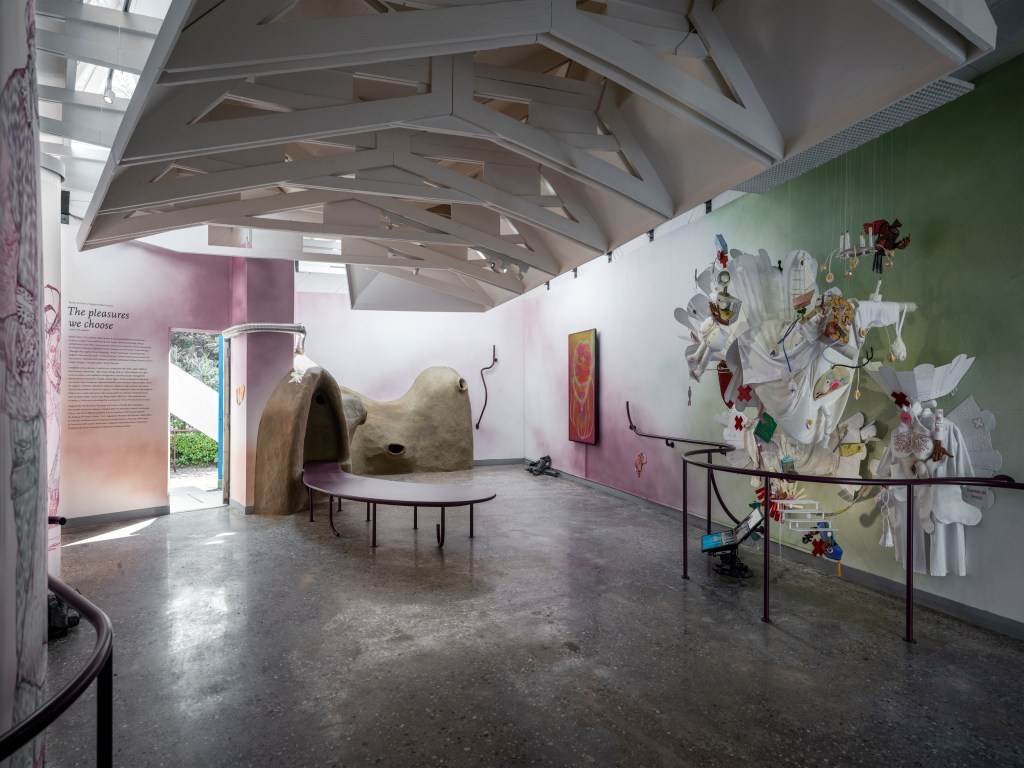
I use this summary of Finland’s recent history as a precursor to understanding the artists and work that represent Finland in this year’s Pavilion, The pleasures we choose, to address Adriano Pedrosa’s theme, which highlights that we are all foreigners at some point, and thus each one of us navigates the spectrum of complexities that come with moving across geo-political and cultural borders. The post-war period was rich in Finnish innovation, design, and architecture, and its quick embrace of Modernism gave it a participatory cultural voice on the international level. Alvar Aalto, who designed the Finnish Pavilion (1956) in the Giardini, which houses the Finnish Biennale artists, is probably Finland’s most internationally well-respected architect. How does one honor this historic structure imbued with Modernist ideas for space, while also exhibiting work that speaks to contemporaneous issues— and would also move us through a poetic lens? The commissioning organization, Frame Contemporary Art Finland, selected the artists Pia Lindman, Vidha Saumya, and Jenni-Juulia Wallinheimo-Heimonen, and their presentation is curated by Yvonne Billimore & Jussi Koitela. As a group they chose to intertwine work from different mediums engaged specifically with the body. What I have to say about this outcome is, whatever happened to less is more— one of the pillars of Modernism and the leading principles of Finnish philosophy and way of life, still today?
For such a small exhibiting space, the Pavilion would’ve had a stronger presentation by standing behind one artist, whose struggles and questions pertain specifically to Finland’s place in this discussion and can understand this country’s felt history and place in it today, by giving them a real voice in this historic space. It also seemed that out of the three artists selected, the most mature presentation of work was by artist Jenni-Juulia Wallinheimo-Heimonen: How Great is Your Darkness (2024) an installation comprised of two hanging sculptures made mostly out of needlepoint that took 16 months to sew together with her own hands, and short videos. Though the three artists were chosen to be presented as collaborators, each work and its presentation couldn’t be more different from the next, and hardly speaks to the constant dialogue, exchange, and interconnectedness of work that results from true collaboration. I will focus on the Wallinheimo-Heimonen’s contribution, as her work revealed a more compelling pursuit of her craft, playfulness, and the need to push the limits of her medium of needlework, which is also closely tied to a local Finnish history of traditional handicraft. Being inventive with needlepoint as a form of sculpture and assemblage has transformed reusable fabric to extraordinary lengths, in sensational ways, that stood on its own, but also fulfilled the expectations of intellectualizing art on questions of identity, that was often prevalent at the Biennale, and noticeable in this curation.
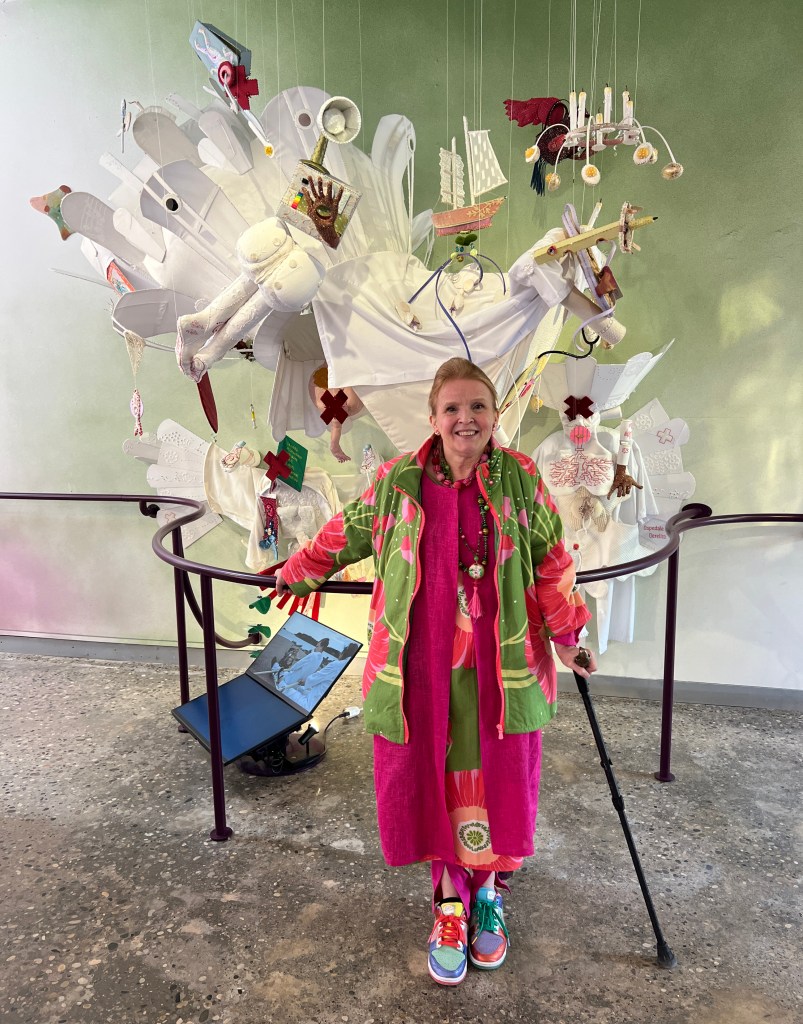
Photo: Amanda Millet-Sorsa
We can feel Wallinheimo-Heimonen’s handicraft at work, sewing together imaginative, surrealistic, and witty forms with varied textures and colors of repurposed textile from matte, shimmer, lace, sequins, and studs are sculpted into solid, recognizable but reimagined objects, using fragments of the human body that call on the sense of touch and sight through exaggerated humor and absurdity. The overall hanging installation How Great is Your Darkness (2024) suggests a flying white angel. Though an angel would usually imply the Heavens, perhaps playing a protective tune, Wallinheimo-Heimonen’s work references some of the skewed power dynamics felt by people with disabilities within the medical sphere. We can observe references to medical care structures with symbols like the white doctor’s coat, the red cross, and stethoscopes. The hanging sculpture on its own is a combination of cross-sections of objects, where you can feel her imagination and improvisation of her hand at work, like a violinist might improvise surrounding a folk tune, giving us a peak into some of the issues experienced by people with impaired mobility where the body and its relationship to others is constantly being challenged.
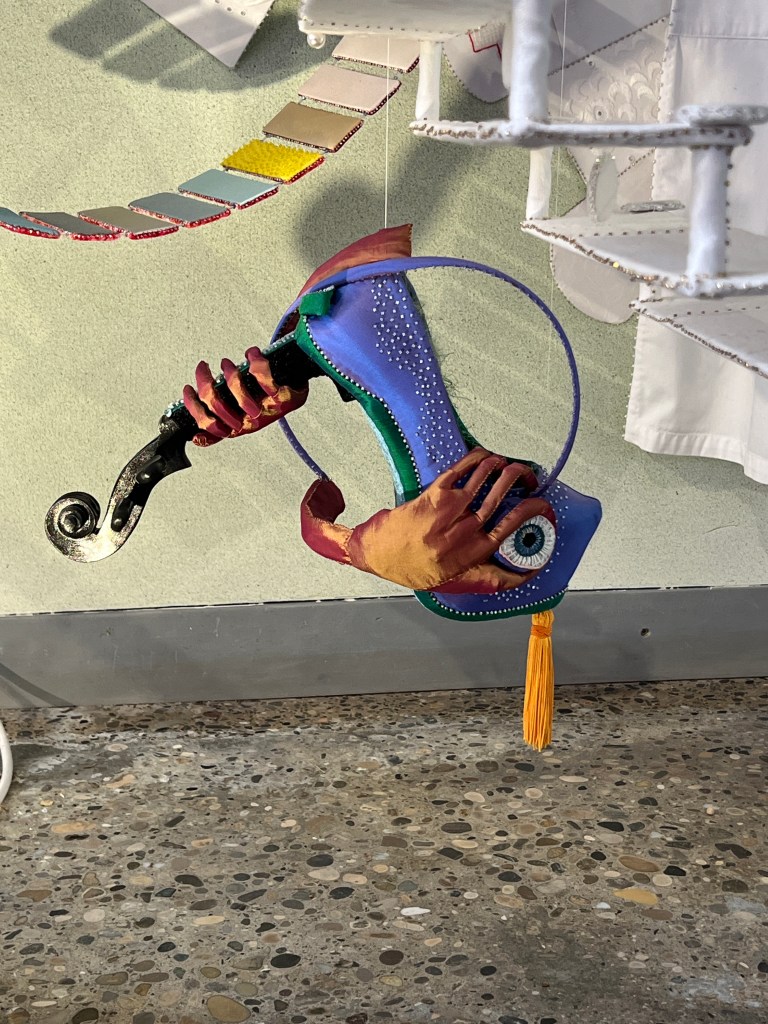
Photo: Amanda Millet-Sorsa
Wallinheimo-Heimonen has had a lifelong struggle with mobility and is active in her disabled community. She has dealt with a medical system in Finland that hasn’t always treated her community with respect and dignity, and her work aims to take back power through humor, found fabrics, and needlepoint, while highlighting some of the prejudices experienced by people with disabilities. With an active imagination for needlepoint, we see a studded purple high heel being held by two hands each, holding an eyeball on the shoe and its heel morphed into a violin neck. There is a pink-purple humanoid form with a small baby’s foot and belly button in one, as if emerging from the womb, hiding under the medical coat. We can also observe the Santa Lucia crown, typical of Nordic religious celebrations, usually bestowed upon the Nordic ideal of the prettiest fairest girl, with candles elongating themselves into a hard-boiled egg. The satire, fantasy, and grotesque of Hieronymus Bosch comes to mind, whose masterpieces we can see at the Accademia, where one must look closely at the smaller mischievous worlds within the larger landscape. As our world politics become more complex and consumed by wars, our societies will have increased populations with lifelong mobility challenges added to those born with complex bodies, and our societies will navigate their place within the power structures of doctors and patients. Her work and experience seem timely and pressing enough to give it a main stage: the work is inventive and imaginative, providing an experience for the senses, and effective in using satire as an entry into dark and uncomfortable subjects. The presentation of the work deserved to be shown in ample space, rather than stuck against a narrow entrance wall and disrupted by a barrier, which also served as a supportive banister.
Finland has a robust system of governmental grants and some private foundations to support artists making work, yet such a cramped presentation gave the impression that there isn’t enough time and thought given to such an important international presentation of artists in Finland, dealing with its own nation’s complex questions of social identity, especially as right-wing governments are gaining more power and ground in European countries. Perhaps the selection process should in fact consist of an outsider’s eye from the long-time commissioning organization. In the end it is taking risks that bears the most fruit and sometimes also the most interesting failures.

| Amanda Millet-Sorsa (US/FR/FI) is an artist, art writer, and arts worker in New York City. |
 Theorema
Leave a comment