
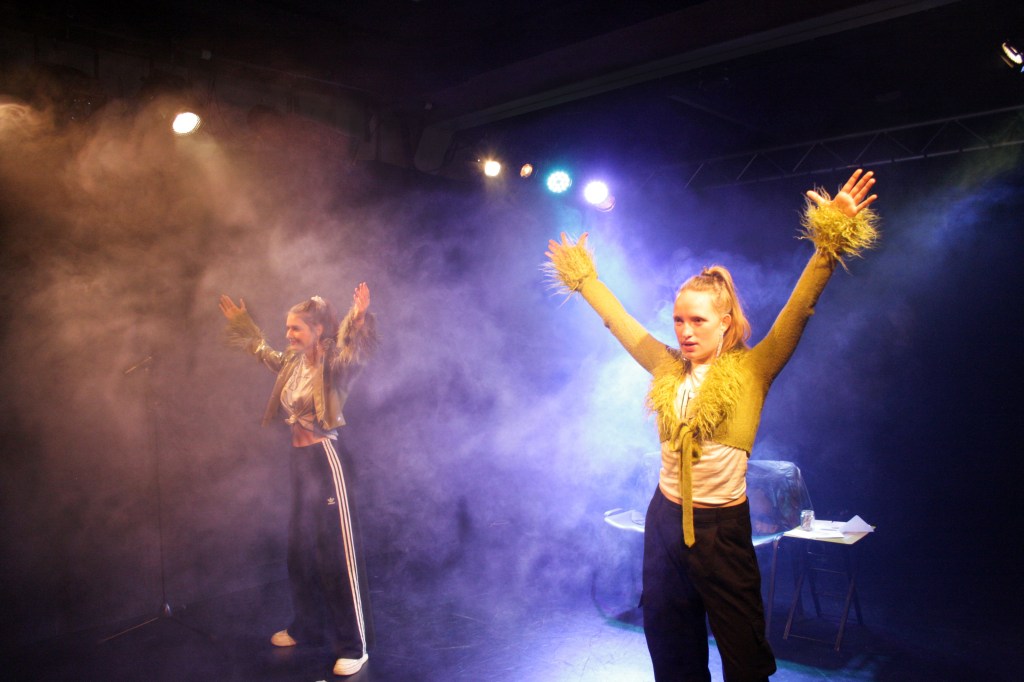
by Marina Dumont-Anastassiadou & Linda Kokkores
MY BEST FRIEND – ODER ICH HARRE MIT UNGEDULD DEINER ANTWORT [My best friend – or, I await your answer with impatience]
Text, concept, staging and performance: Mira Leibold and Luzia Oppermann.
Lighting and technical support: René BuscherPresented on February 17, 2024 at Cammerspiele Leipzig.
[Bias Disclaimer: Mira Leibold and Luzia Oppermann are friends and occasional artistic collaborators of the authors.]
The stage is mostly empty. The set consists of two plastic chairs and two microphones. A clear contrast to the auditorium of the Cammerspiele, an independent theatre in Leipzig, which is sold out down to the last seat.
On this February evening, the audience consists of small groups of friends, noticeably many of whom are female. Among them are us, two friends who have come to see the play My best friend – oder ich harre mit Ungeduld deiner Antwort [My best friend – or, I await your answer with impatience].
As soon as we walked in, we felt at ease, at home with friends. Because the two actresses were preparing on sight, they were coming and going, still placing one object or the other on the stage, disappearing, returning, greeting those they knew, whispering (and maybe gossiping about what was happening in the room). This was their home.
We happen to know the show’s creators, Luzia Oppermann and Mira Leibold, two actresses recently established in Leipzig. Together they conceived the evening and they are the only two performers on stage. We also know that they are best friends. That’s how they define themselves. For some time now, this expression, more reminiscent of schoolyards than the adult world, has been making the rounds again. Instead of vague all-purpose phrases like “childhood friend”, “good friend”, “very close friend”, there seems to be a reclaiming of the “best friend” label. What this term entails, and why it’s so important to use this label, is what the play about these two friends sets out to explore.
It originally premiered in March 2023 at the Gerhart-Hauptmann Theater in Görlitz Zittau with limited resources, no big set and no large space. In February 2024 it was revived at Leipzig’s Cammerspiele, a small but popular venue and central production site of the local “freie Szene” [off-scene]. The show is genre-fluid. It doesn’t strictly follow a narrative structure but consists mostly of different episodes that intertwine. It resembles a never-ending, ever-branching conversation. The stage is not meant to represent anything else, the friends’ imagination and creativity transform it into a space that merges past and future, present and dream.
The show begins with a short introduction, just enough to tell us who they are and what they want to show us. Except that it doesn’t work. They’re not happy with the result, they start again, try different ways, more theatrical, more jovial, more articulate. And once it seems to be over, one of them has to go to the bathroom. When she comes back, the other one needs to go. This chaotic, fragmented, work-in-progress introduction sets the tone: this is a trial run, they are exploring something. Here, we will see them being together, searching together without any fear of failing. We watch two friends questioning friendship not only on a theoretical or theatrical level, but intimately, in front of us. They reveal themselves and their relationship in order to dive deeper into what they understand about their bond. The play presents itself as a return to the roots of friendship between women, particularly the friendship of the two performers, and the show that grew out of it.
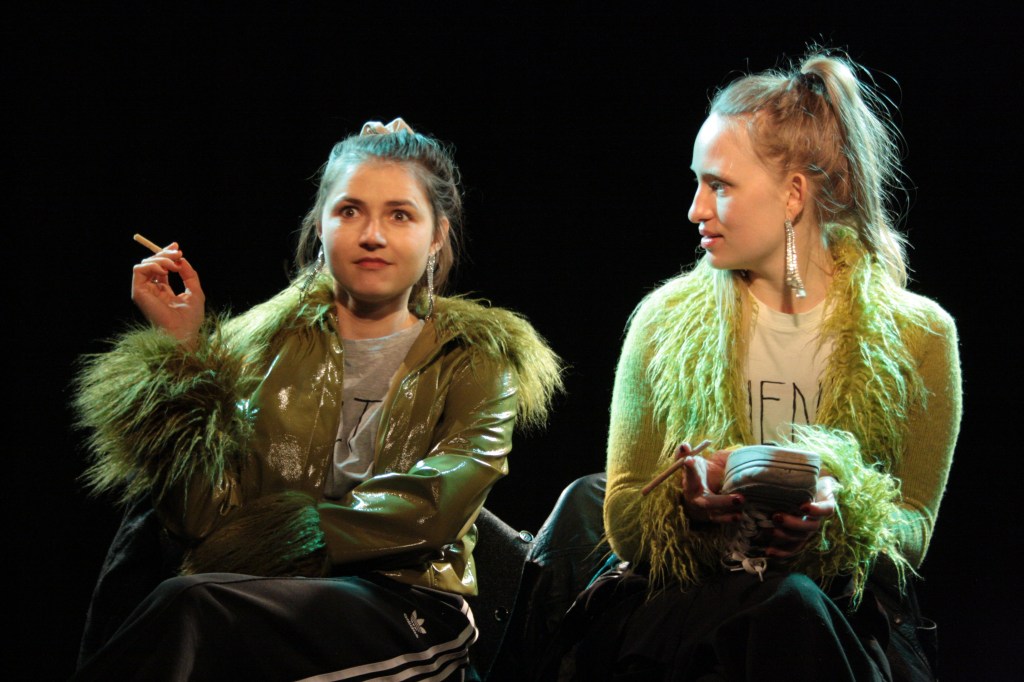
Once the u-turn of the chaotic beginning has been made, Luzia and Mira proceed with a little reminder of how friendship between women was perceived over the past centuries in the West. In short: It wasn’t terrific, to say the least. Certain influential men like Michel de Montaigne even went through the effort of discrediting this connection as ridiculous and even denied women the intellectual capacity and emotional stability for friendship1, while in the German-speaking world in particular, the friendly correspondence of male writers was magnified and placed in the spotlight. Yet there have been some great stories and documents of female friendship, as we are reminded throughout the evening. One of them being the unconditional friendship between Clara Zetkin and Rosa Luxemburg. During the First World War war and in the two years that followed, until Rosa Luxemburg’s death in 1919, the two German women, both leftist and committed revolutionaries, wrote each other letters that bear witness to a deep bond.
Luzia and Mira read some of the excerpts. The words used are powerful, and remind us of how even today, two friends can use passionate terms. The choice of this particular story is obviously not insignificant, considering that we’re in Leipzig, the inextricable city of Zetkin’s biography, as the huge park in the centre of the town bearing her name testifies.
Hearing these old letters, where militant considerations, feminism, the consequences of war and the sweetness of friendship blend, gave a profoundly political dimension to this female friendship. In this way, the actresses emphasised the weight of friendship in a resolutely political perspective and anchored their personal decisions (living together as roommates, prioritising their relationship over a romantic one) in a broader ideological perspective.
The friendship we witness is indeed just as intense. It’s told through nicknames (“baby” is used several times throughout the evening), children’s games, and poems that the protagonists write for each other. This is a competition of love: each is sweeter, more exuberant in her attachment. The last scene is particularly touching, because it is unrehearsed and raw. Luzia and Mira read letters they’ve written for each other. The night we visited the show was supposed to be the last one (and until now it has been the last). Both actresses had saved their letter for that evening. This final episode, resolutely performative, took us into the intimacy of the artists. What was played out on stage was in fact not played out at all. We were put in the position of first-hand witnesses to declarations of friendship. The letter, as a means of communication, obviously echoed the way Rosa Luxembourg and Clara Zetkin communicated.
The question of communication in friendship is at the heart of Luzia and Mira’s experiment. Contemporary communication techniques are integrated into the performance through several scenes that highlight how the two friends try to overcome the physical distance that often separates them. Voice memos and messages or long telephone calls from a random train in Germany are episodes of a daily life that Clara Zetkin and Rosa Luxembourg might have shared if they had lived today. In the case of both activists, the distance was overcome thanks to passionate letters, sometimes full of the frustration caused by the rhythm of the exchanges and poor timing (with letters crossing each other). Luzia and Mira, on the other hand, must deal with an unstable network, frequent but choppy conversations that unfortunately only give the impression of ignoring space but can’t totally overcome its limits. Frustration remains. Where technology seems to remain an empty promise of permanent availability, the friends try their hardest to be there for each other, taking time in every life situation to discuss mundane matters and emergencies by sharing small successes in their everyday life or singing a lullaby together over the phone on a sleepless anxiety ridden night.
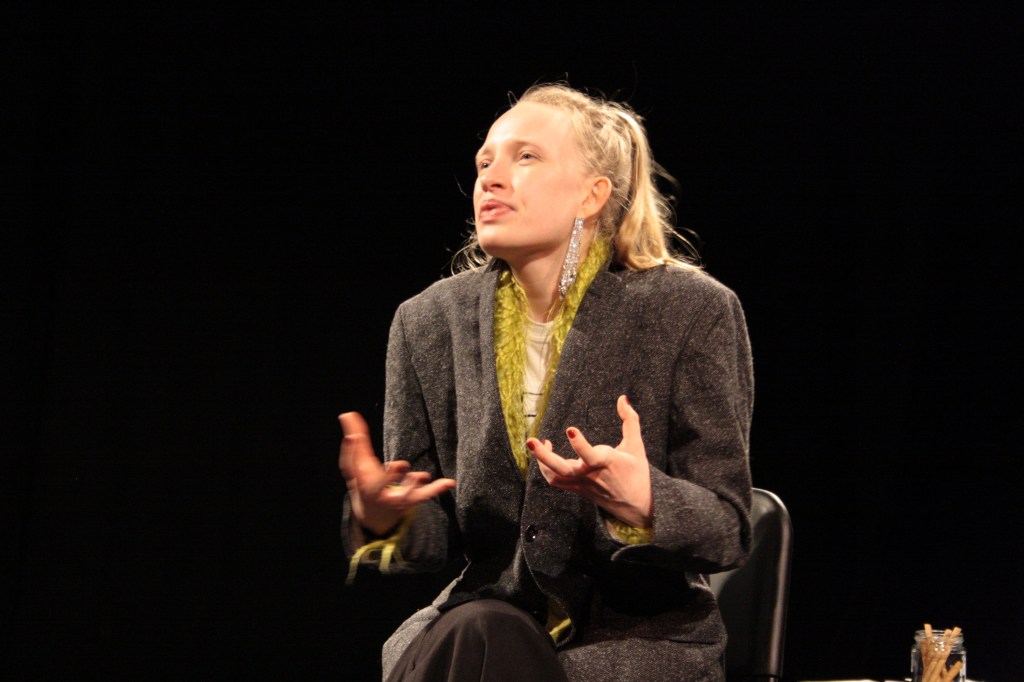
Simultaneously, friendship is also a certain expression of empowerment and rebellion. Opulence, maximalism and sensory overload have dominated Leipzig’s institutional and state-funded stages, both in drama and opera, for many months. At the same time, a vague concept of sustainability is repeatedly mentioned but not specified and does not venture from announcement texts and press statements onto the stage. What could be more sustainable than two friends developing a play about female friendship together, acting as authors, directors and performers at the same time? In a multilayered performative act, they succeed in writing roles for themselves and each other, thereby creating an opportunity to showcase their artistic craft with almost no resources available.
In one tableau, the process of searching for an acting work and endless casting sessions is dissected in another childlike play situation. Luzia imagines her guest appearance in a fictitious talk show dedicated to her successful career as an actress. She introduces herself as “Mr. Oppermann” and talks at length about the difficulties that have accompanied him as a male actor in the past and determine the future of his work. It is a clear reversal of the reality faced by countless women in the industry. Mira as the talk show host gives her friend the floor and the opportunity to speak out about injustice and inequality. The two women provide each other a stage in the literal sense to voice their struggles, their thoughts and feelings.
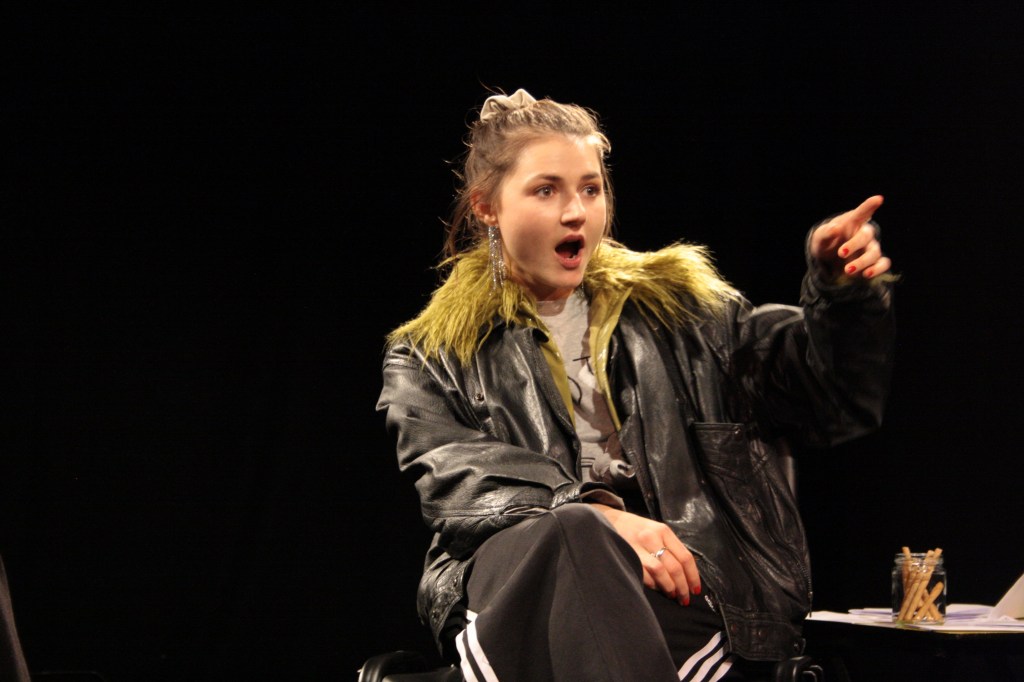
The friendship portrayed here could replace a romantic relationship. This is explicitly stated. Strangely enough, in this kind of relationship, it seems that we can’t get beyond the model of the nuclear family, the nodal couple. The counter-model that is being developed here to the heteronormative relationship does not call into question one of the foundations of the couple: a being born from the fusion of two beings. The meeting of two souls seems, once more, to signify the transformation into a new being, which, if it were to be split up again, would produce an immense void in the world.
In fact, Luzia and Mira’s account of this nuclear friendship resembles the traditional “Prince Charming” tale at the heart of the romantic couple’s thinking. One of the show’s central episodes makes use of narrative mechanisms of a fairytale. Luzia (or Luzia’s character) sets out in search of a best friend. The search is constructed in exactly the same way as a traditional tale, with twists and turns, various encounters that yield nothing, and finally, just when she’s about to give up, a happy chance encounter on the bench where she was taking a break next to a woman who turns out to be the best friend she’s been waiting for. This is Prince Charming’s adventure. The friendship we’re talking about here is directly associated with this imaginary magical encounter that saves the day and implies living happily ever after.
The performance ends with a return to the origins of the show’s creation. The two friends, who have just met, look at each other full of love and decide to put on a show about their friendship. Back to the beginning. And here comes the unveiling of what this creative experience was like for two actresses who have gone to the other side of the stage. Writing and directing, as a creative adventure, is like experimenting with a friendship that has to claim its own story.
| Marina Dumont-Anastassiadou and Linda Kokkores (DE/FR/GR) collaborate on multilingual films and interdisciplinary formats between performing arts, writing and installations. They work mainly in France, Germany and Greece. |
- Michel de Montaigne, “On Friendship,” in Essays, Book 1, Chapter 27. ↩︎
 Theorema
Leave a comment