
by Auli Särkiö
ET LE PASSÉ REVIT LE TEMPS D’UNE VISITE
Markus Jäntti-Tuominen & Walter Sallinen.
Book with CD published by Argobooks, 2022The ten videos that resulted from the process (2022):
https://markusjaentti.com/Et-le-passe-revit-le-temps-d-une-visite-And-the-past-comes-alive
Collaborative artworks call into question the status and authority of the artist. They can also engage our thoughts on the audience experience in a different way compared to works created by a single author – the traditional way artistic work is understood. If the provenance of a work lies between multiple creative minds and sources, what is the creative role of the audience? Collaborative projects may also explicitly focus on collectivity and the non-traceability of origin. They also tend to search alternative expressions to work of art conventionally seen as a single defined object with clear outlines.
In Finland, recent examples could include Woyzeck Game, a multi-level participatory experient by Live Art Society, Oratorio, a walk-along urban poem by writer Saila Susiluoto and sound artist Antti Nykyri, or the HNV Collective, an interdisciplinary group of artists merging artistic exploration with scientific processes.
It comes very naturally that these kinds of collaborations should blur the boundaries between different artistic fields. A genuine collaborative process delves into these boundaries and gives space for the artists to develop their practices together from the very start. This takes time, as exemplified by the collaboration of harpsichordist Marianna Henriksson and dancer/choreographer Anna Mustonen since 2012. Their stage performances (e.g. Eros, 2022) combine early baroque music and contemporary dance in a way that lets the respective art forms flow into each other. An organic whole where every participant contributes to the process cannot be achieved in the limited time-frame normally scheduled to performing arts in institutions. [editor’s note: a performance reviewed by Aleksi Barrière for Theorema]
***
In this text I will focus on a project by Finnish artists Markus Jäntti-Tuominen and Walter Sallinen. The work in question, entitled Et le passé revit le temps d’une visite (‘And the past comes alive again for a visit’) is a complex interdisciplinary project encompassing several years and co-collaborators and combining conceptual, visual and sound arts. As a fragmentary, edgy, seemingly random whole of gestures and procedures, the work deals with the demarcation lines of artworks and authors.
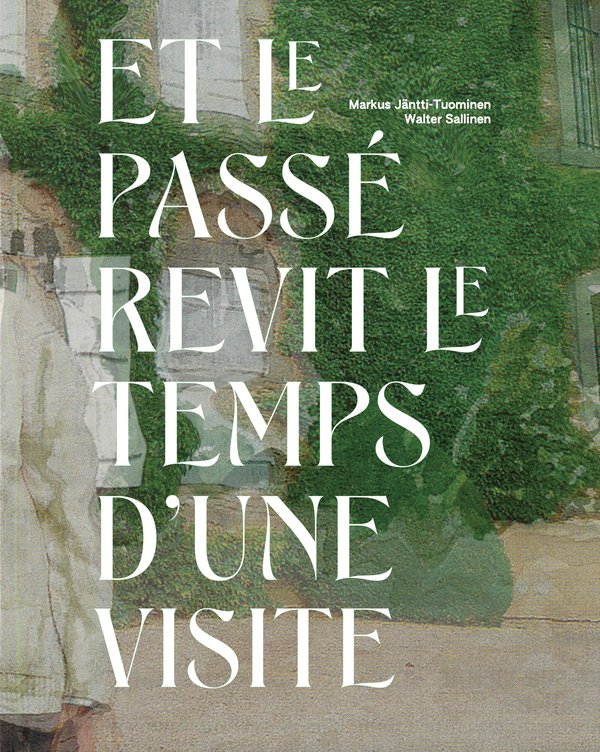
Starting already in 2016, the project culminated in Berlin in Autumn 2022 with the publication of a catalogue that brings together the many layers of the project in a physical form and, with the help of QR codes, serves as a gateway to materials online. The booklet looks like an exhibition catalogue including various texts, photos of Jäntti-Tuominen’s artworks and a CD with Sallinen’s acousmatic compositions. I first imagined that the catalogue follows an exhibition of the duo with paintings, sculptures and sound art, but no such event took place. Instead, a documentary film about the project was screened in October, hosted by the Finnish Institute in Germany. The visual and auditory aspects of the work are united in a collection of videos the artist made together, embedded in the documentary and accessed via links found in the catalogue.
This is nothing new for Markus Jäntti-Tuominen (b. 1994) and Walter Sallinen (b. 1991) who have been exploring artistic collaborations for several years, in various contexts. Jäntti-Tuominen works among others with mixed media, film and sculpture resulting for example in a puppet animation about Brexit. Sallinen’s output includes for instance multimedia works and installations. With dramaturg Klaus Maunuksela and sound designer Kaj Mäki-Ullakko (both also appearing in the project in question) he designed UXO, an electroacoustic ‘sound ritual’ with strong emphasis on performance art, premiered at the 2019 Helsinki Festival.
Both Sallinen and Jäntti-Tuominen are keen to group with friends and colleagues and slip into cracks between genres and forms. They are not interested in expressing subjective insights or producing something original or ‘authentic’. Rather, they seem both fascinated by the impossibility of authenticity in today’s culture, dominated by social media and global consumerism. This is clearly visible-audible in Et le passé revit le temps d’une visite, which interests itself in materiality and anonymity of art. It expresses itself with banalities and citations that dissolve into an uncanny reflection of reality. However, the artists do not step aside as mere spectators and copy-pasters of reality. I’m intrigued with the somewhat paradoxical relationship between the randomness of fleeting details and the solemnly executed work and craftsmanship with which the collected materials are processed.
***
The starting point and inspiration of the project lies in another artistic collaboration, that of Viktor Hartmann and Modest Mussorgsky, who composed his Pictures at an Exhibition (1874) after viewing Hartmann’s – a friend who had recently died – paintings and drawings. Almost nothing remains of the original material of these works, and certainly nothing of their aesthetics. That is the intention, as it is the method of collaboration and form of realisation that is recreated by Jäntti-Tuominen and Sallinen, not the content of the 19th century artists’ work.
Mussorgsky’s work serves as a paradigm for interdisciplinary collaboration that is the opposite of Wagner’s Gesamtkunstwerk: instead of a fusional unity given the spectators as an overwhelming, illusionary and ritualistic whole, a fragmentary, almost game-like corpus of materials that intermingle and invite the participator to join.
Jäntti-Tuominen used the titles and descriptions of Mussorgsky’s piano pieces to produce his own visual interpretations of them. Sallinen, in his turn, took Jäntti-Tuominen’s work as reference for his compositions that accompany each ‘picture’. To carry out this concept, the visual artist arranged a private exhibition in his parents house and invited the composer to visit it, walking from picture to picture as Mussorgsky did.
The walk through the exhibition forms the basis of the 40-minute documentary film, sharing the name of the entire work, which incorporates Sallinen’s visit in the ‘exhibition’ and the ‘music videos’, short animated films that the duo realised together as the last phase of the project. It is precisely these films, played in the documentary like cut-scenes in an adventure video game, where the Jäntti-Tuominen/Sallinen-collaboration is crystallised, their visual and sonic conceptions coming together. But Et le passé revit le temps d’une visite denies the idea of dialectical synthesis of Gesamtkunstwerk – the total artwork where everything finally comes together as a harmonious whole.
***
We are engaged in a process where the result is less important than the making-of. That is where the involvement of us, the audience as participants, comes into play. The work named Et le passé revit le temps d’une visite is not located in the catalogue with its pictures, various texts and screen-shots, or in the documentary film, or in the CD. It is certainly not situated in the original exhibition, as it was a private event held only for Walter Sallinen and filmed by the duo’s collaborators.
The catalogue in hand, we are invited to browse through the material and create our own itinerary, only marginally controlled by the authors. We can choose the amount we are ready to take in: maybe only the pictures in the booklet, some of the videos via embedded QR links, or the music, organised as an acousmatic recital on the CD found inside the sleeve of the catalogue. Or we can examine all the parts and levels offered to us, read and reread the background information – an interview with the artists, their preface and an essay by Jörg Heiser, reflecting on the idea of Gesamtkunstwerk and the notion of self. Or we can just acquaint ourselves briefly with the overall idea of the work and maybe come back to it later – the duration of our visit is not limited as it would be in a gallery or in a live concert. We can always come back to the work, both to the physical catalogue and the material online. It is not clear where the work begins or ends. In my mind, I keep coming back to the dark corridors of the house where Jäntti-Tuominen’s pictures were hung, juxtaposed with one another and making Walter Sallinen go around and search for the next item, some of them found in the basement or in narrow staircases.
***
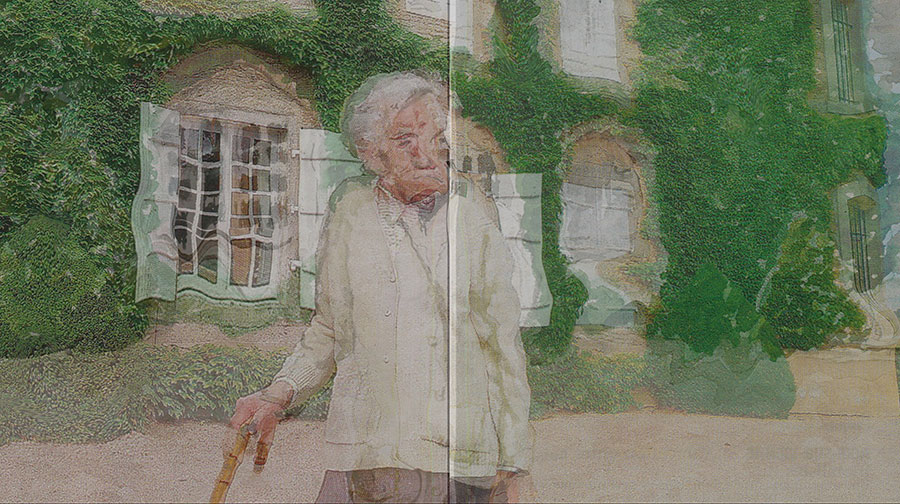
Looking at the cover of the catalogue, seeing the art-nouveau-like font of the title and the old house covered by greenery pictured on it, one may imagine that this is a work elaborately philosophising on memory, time and space, in the manner of Proust. It turns out that the beautifully-sounding phrase of the title is just a headline taken out of a French local newspaper, random words on a flat surface. However, this odd and enigmatic phrase sets us – as it did the artists – on a whole journey of associations. Et le passé revit le temps d’une visite does not go deep – the task normally assigned to artworks. It scurries in every direction over a flat everyday surface teeming with associations. These chains of associations, traces and influences wriggle and squirm, they are repeated, used and scraped. They keep changing and decaying.
In the central work of the project, the video La Grande Nouvelle, a French newspaper comes to life, zooming in to grainy details and metamorphosing into weird watercolours. This is something typical for the duo: taking something overly familiar and banal – like a garden gnome – and changing it to something uncanny. Sallinen has taken samples as the basic material for his sound art, willingly evading everything ‘genuine’. Only a couple of times does he use a tiny portion from the original Mussorgsky piano pieces; rather his material includes snatches of a MasterChef show tune, a baby’s breathing and a Bach keyboard piece totally distorted with sounds from the Finnish-Japanese Moomin TV series.
As Mussorgsky used his impressions at the exhibition as a starting point for his compositions, Jäntti-Tuominen and Sallinen gave initiative to the first impressions evoked by the Russian artists and each other’s work. They followed a chain of momentary thoughts and particularities. The traditionally valued artistic brainwork of original ideas and truths has given way to a pronouncedly meticulous and seemingly random process. Markus Jäntti-Tuominen travelled to Poland, France and Italy in search of places and things mentioned in the Mussorgsky titles (Tuileries, an old castle, a polish ox wagon…). Walter Sallinen gathered samples on the internet – the great outdoors of the postmodern artist – and manipulated his material, working with triggers, loopers and various other electroacoustic techniques to create a grainy, scratchy, twitchy-glitchy sound world that doesn’t offer a solace of aesthetic pleasure but rather makes as slip and trip. The artists are not creating an object of art for us to take refuge in. They are examining and processing their surroundings with sometimes airy or even humorous, sometimes unsettling ways in order to make sense of our world.
The visual artist goes to Poland in search of local logos that have a round shape mirroring the wheels of an ox cart. The composer works on the sounds of Polish commercials to create portraits of a poor and a rich person, as depicted in Viktor Hartmann’s portrait of two jews. Baba Yaga the ghoul and her hut turn into a cuckoo clock which Sallinen translates into a grotesque mechanical bird-song using samples of Trump speeches. Hartmann’s sketch for a ballet set design, ‘Ballet of Unhatched Chics’, turns into a cross stitch work of two persons inside their social bubbles like eggshells, passing each other on a meadow of social media logos. Mussorgsky’s beloved dance of the hopping chicks is used to draw a choreography of three sequences of steps wandering on sand and drifting further from each other. The project reflects how artists with seemingly different means and media meet on their explorative route and come together with very similar interests and viewpoints.
***
I found my Et le passé experience at times unnervingly uncomfortable, as was the performance of Sallinen’s UXO experienced in absolute darkness. It was also something witty, finny and awkwardly casual like Jäntti-Tuominen’s unicorn sculptures.
Meanings arise in a moment, they are evoked and carried over in a flow that is continuously disrupted and on the verge of effacing itself. Past, present and future are looped in an interrupted dialogue typical of our age. In fact, Mussorgsky composing his piano pieces did not have an actual interdisciplinary conversation with his architect-painter friend, since Hartmann’s exhibition was actually organised to commemorate the deceased artist; in the ‘Catacomb’ movement of the piano cycle an eerie intermezzo intervenes entitled ‘Cum mortuis in lingua mortua’ (With the Dead in a Dead Language). Here the composer is tentatively trying to reach his dead friend, and maybe himself, too.
The CD attached to the catalogue starts with a piece called Schizophonic Self-Portrait, perhaps referencing the ‘Promenade’ interludes in Mussorgsky’s composition that depict, almost as in real time, the walk in the gallery and the constantly changing moods and thoughts of the visitor. Schizophonic Self-Portrait consists of a Finnish palindrome, ‘Nätin äänesi sen äänitän’ (Your sweet voice, I will record it) spoken by Sallinen. This incantation of the TikTok age is multiplied and transformed until it dissolves into an electrified, robot-like blur. On the video linked to the acousmatic piece the digitally drawn, a naive Kindergarten-style self-portrait of Jäntti-Tuominen is creepily transformed into a rotating 3D-head, like that of a vintage doll or a plastic skull.
What we are dealing with here is not, however, the infinite irony identified with postmodernism. In their quest for the impossible authenticity the artists result, almost accidentally, in creating a world of child-like ingenuity, fearfulness, pleasure, and wonder.
When I examine the drawing behind the video, entitled Självporträtt 1/2 (using the Swedish word for self-portrait), I notice it is dated in Paris and has a skull and a bone placed around the figure like in a tombstone. The ‘Catacomb’ movement by Mussorgsky is never referenced in the texts of the Et le passé catalogue, but this clearly is the Paris catacomb where Hartmann self-portrayed himself examining the vestiges and which gave Mussorgsky the idea of arranging a meeting in the dark with his dead friend.
The present-day artists are scavenging the underground tunnels and reaching to each other from behind walls (there is also a little affectionate digital drawing on the sleeve of the catalogue depicting the two friends in Paris). However, the skull and the bone framing Jäntti-Tuominen’s self-portrait are also very well suited to represent the pirate flag, signalling the boisterous journey of sampling and looting the two are off to, sailing the infinite seas.
| Auli Särkiö (b. 1990) is a Finnish poet & writer working mainly in and around classical music. |
 Theorema
Leave a comment